Pages

Saturday, 19 November 2016

Arthur S. Hoffman - Profile of Fritz Duquesne, adventurer


Fritz Duquesne was an adventurer who wrote some stories for Adventure magazine.

  • Sekokoeni’s Raid (ar) Dec 1910
  • The Man-Eaters of M’wembi (ar) Jan 1911
  • When the Rain Was Red (ss) Sep 1911
  • The Fighting Dwarfs of the Congo (ar) Jun 1912
  • A Fire-Hunt at Kivu (ar) Dec 1913
Adventurer and Avenger - article about Fritz Duquesne by Arthur S. Hoffman in Adventure magazine, April 1938


He's the subject of the only article written by Arthur S. Hoffman for Adventure magazine in April 1938. It's an interesting profile; Hoffman was a patriot, and Duquesne was so against the British that he actively supported Germany in both World Wars. In spite of being on opposite sides, it seems to me that Hoffman respected Duquesne, even as he didn't agree with him.

The facts may be questioned, the impression from the article is of a man forged hard by tragedy to become an avenger with a tragic life. You can read it here.

Tuesday, 15 November 2016

Pulp AdventureCon 2016

Photos:

Pulp AdventureCon 2016 - Panoramic View
Pulp AdventureCon 2016 - Panoramic View (click to see more detail)

Dealers are collectors too

Some rare magazines and books

John Gunnison of Adventure House had this new line of pulp art there

John Gunnison of Adventure House had this new line of pulp art there

Many old magazines (Collier's, American Weekly, Saturday Evening Post) on sale

Science fiction digests, paperbacks and dime novels going cheap

I raided the Short Stories box and came away with about 10 issues

Comics from Basement Comics

The Pulp Mafia - (L-R) - Ed Hulse, Scott Hartshorn, Digges LaTouche, Walker Martin

Movie poster for Bulldog Drummond at Bay

Some of the costlier pulps
Some more of the costlier pulps


Mike Chomko had the latest books from Altus Press


Really nice issues of Dime Mystery


Strange Stories from August 1939 - cover by Earle Bergey

Original Art by Hannes Bok from a detective pulp


Some interesting books - Red Book had Dashiell Hammet's 1st appearance of The Thin Man

Scott Hartshorn had some interesting Tarzan artwork

This art appeared in a newspaper comic strip

My find of the show - an early issue of Short Stories from 1915


Movies on DVD - the titles are interesting

Sunday, 30 October 2016

Dee Linford - Western Author, Journalist, Technical Writer

Dee Linford is not a well known author today, remembered if at all as the author of the story Man Without A Star, which was made into two movies, Man Without A Star (1955), A Man Called Gannon (1968), and an episode of a TV series, The Virginian, in 1963.

He wrote a series of stories about Sudden John Irons, a range detective. I liked a couple of stories of his in Short Stories magazine, especially Dead Man’s Dome in the August 25, 1948 issue. It begins with this passage:
CHAPTER I
FUGITIVE TOWN

THE sign was a crudely lettered shingle, nailed to the trunk of the only tree in sight. "Welcome to Wildcat,” it bade the stranger—expressing in three short words the whole timeless spirit of friendly optimism on which such towns are founded. But the town itself was nowhere in sight.

Stub Williams, so called because of his unusual angular height, sat hunched on the spring seat of his high-bedded wagon, looking at the sign and at the sentinel cottonwood which rose like a skeleton above the rubbish-littered flat. Weighing a problem in his mind.

The sign was in the right. The sign had to be in the right. The map the saloonman had sketched for Stub in Casper had placed the town squarely between the forks of Deadman Creek, here on the Poison Spider Plains.

Well, Stub was sitting within sight of Big Deadman, to his right, and Dry Deadman, to his left. And there was the sign welcoming him to town. The rubbish scattered around showed the town had been there, no more than a week before. But the town, clearly, was not there today.

The whole setup was baffling, and slightly eerie. Stub rubbed the back of his sunburned neck and looked quickly behind him, as if expecting to find the missing community of five thousand souls stalking him from the rear. But he saw only the bleaching bones and rusty tin cans. The heaps of whiskey bottles where the saloons had stood. The fly-crawling refuse and charred debris of what once had been a thriving town. A town where Merrybelle had lived, wanting to have a well sunk.

How can you not go reading on after that? I did; it's a story of a rich man dominating an entire town, with a stranger riding in to rescue the exploited townsfolk, a theme to which Dee returned many times.
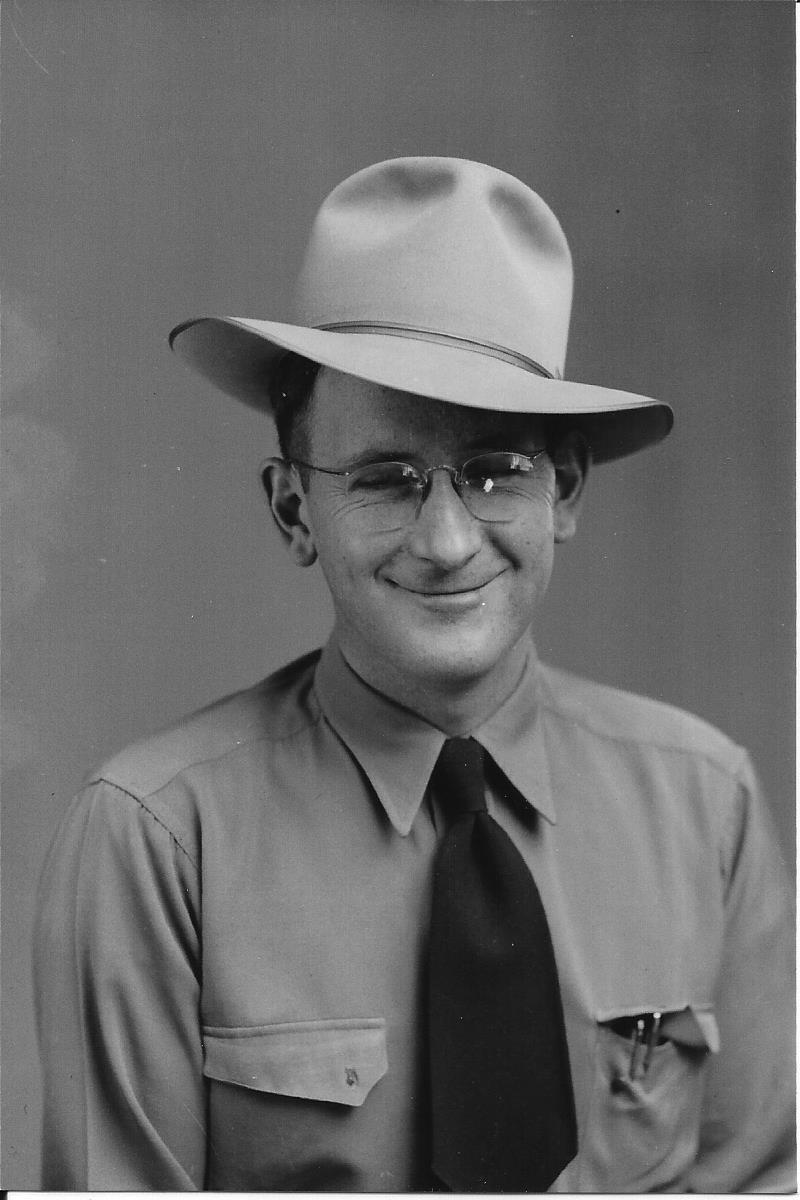
DeVerl (Dee) Linford, pulp western author (Undated photo courtesy FamilySearch,org)

Deverl (Dee) Hess Linford was born on March 3, 1915 in Afton, Wyoming, a town on a section of the Oregon trail bordering Idaho and Utah, in a grassland valley surrounded by forested mountains. His parents were Joseph Linford and Sarah Hess, both of whom had English and Utahn parents. Joseph Linford had earlier studied at Brigham Young University and moved to Afton where he homesteaded a ranch and worked in the dairy business. This history and backdrop was later used by Dee Linford in some of his stories.

Dee went to the Star Valley High School in Afton, where he was a scholarship student. In 1932, he gave the salutatory address at his high school graduation.

Star Valley High School (Picture courtesy the Kennington and Weber Families blog)
Star Valley High School (Picture courtesy the Kennington and Weber Families blog) 

After that came the University of Wyoming, Laramie where he studied journalism. He worked briefly on the Laramie Republican-Boomerang. In 1934, he married Helen Grace Bagley, also from Afton. She was in the class that graduated one year after he did. They moved to Cheyenne, Wyoming, where he became the editor of the Wyoming Wildlife magazine, published by the Wyoming Game and Fish Commission. In 1938, he was also assisting in the preparation of the WPA Guidebook to Wyoming, Wyoming: a Guide to its History, Highways, and People.

I came across a newspaper report from 1939 that says he had sold his first two stories for $200. His first stories appeared in Dime Western in early 1940, according to the FictionMags index, so this feels right.

In World War 2, Dee served as on the U.S.S. Neshoba, an attack transport ship that operated in the Pacific theatre of war from 1944 to 1946, participating in the battle of Okinawa, travelling from Guam and Saipan to Seattle and San Francisco with POWs and soldiers.

Photo of U.S.S. Neshoba courtesy PriorService.com

During this time, his output dropped to a couple of western stories a year, still an impressive feat considering the conditions he was working under. He didn’t start writing about his war experiences or setting some stories in the area, unlike other writers.

Sometime in the very late 1940s or early 1950s, the Linfords moved to Socorro, New Mexico. Helen joined the New Mexico Institute of Mining and Technology as a professor of mines. Dee went to work in the publications office of the University before becoming a technical writer and editor in the New Mexico State Engineer’s office. It was just as well they did this, the pulp magazine market was collapsing in the early 1950s and they must have financially benefited from the move.

In 1952, Dee published the book “Man without a star” that was subsequently made into the Kirk Douglas starrer, Man Without A Star. The movie has another pulp connection; one of the screenplay authors was Borden Chase, a writer who had moved to California as a studio writer.

Poster for Man Without A Star (Courtesy FilmAffinity.Com)
This book seems to have been the last of his writing career; I can’t find any records of either books or magazine articles/stories written by him after 1952.

In 1954, Helen died unexpectedly of a cerebral hemorrhage, leaving Dee to raise their four children. Dee passed away on August 20, 1971 after a long illness. His papers are at the University of Wyoming’s American Heritage Center.

Monday, 10 October 2016

Kindle edition of Richard Matheson's classic vampire story, I am Legend $2 at Amazon.com


The Kindle edition of Richard Matheson's classic vampire story, I am Legend, is now on sale at Amazon.com for $2. Those of you with an allergy to ebooks can ignore this, others should pick this right up.

Matheson delivers a knockout punch at the end of what seems to be just another apocalyptic "vampires are taking over the world" scenario. Leaves you contemplating the nature of deviation from the mean, and at what point it becomes the new mean...further commentary would spoil the book. Go ahead and get it, it's cheap at the price.

Disable your adblocker to see the Amazon link:

Saturday, 1 October 2016

Clarence Budington Kelland - The transmigration of a sheep

This is a change from the usual content from the pulp magazines - a story from one of the slick magazines - Country Gentleman. This magazine was a sister publication of the Saturday Evening Post, aimed at farmers.

http://www.magazineart.org/main.php/v/farm/countrygentleman/Country+Gentleman+1931-01.jpg.html
Country Gentleman magazine, January 1931 cover courtesy MagazineArt.org

This particular story is one of a series about Scipio Mather, written by Clarence Budington Kelland. The author is not particularly well known today, and if at all remembered, it is as the author of the story behind the Frank Capra movie "Mr. Deeds goes to Washington", and also apparently the originator of this quote about fathers "He didn't tell me how to live; he lived, and let me watch him do it."

 I was put on to the track of these stories by Walker Martin, who mentioned it in passing as a series that he sought out to read - similar to the Alexander Botts stories by William Hazlett Upson that appeared in the Saturday Evening Post. Well, I like the Botts stories a lot, and i recently found out that the public library near me has a complete run of the magazine from 1920ish to 1954. I went and dusted off the volumes (literally blew about 20 years of dust off the top) and read one story, probably the first in the series.

The story is a rags to riches tale told with considerable humor, with a good slice of Yankee ingenuity added. The dialogue between Scipio Mather and the heroine is of the sparkling, charming variety that can be found in good screwball comedies. In the course of this story, Scipio goes from being a wandering man owning a sheep to being a part owner of the local bank, never selling or buying anything, instead bartering his way up the economic and social ladder.

You can read the story here. The complete story's there, but due to my limited success in copying the bound pages, i was unable to keep the illustrations by James C. McKell. The story is from the January 1931 issue of the Country Gentleman.

If you like the story, leave a note in the comments and i'll consider adding more of them.