Pages

Showing posts with label Short Stories. Show all posts

Sunday, 26 August 2018

Canine Covers in honor of National Dog Day


Pick your favorite. Mine's the German Shepherd in the Argosy.

Adventure, July 18, 1919 cover by James Reynolds
Argosy, February 7, 1925 cover by Charles Livingstone Bull
Argosy, February 7, 1925 cover by Charles Livingston Bull
Blue Book, February 1934 cover by Joseph C. Chenoweth
The Popular Magazine, March 20, 1916 cover by John A. Coughlin
The Popular Magazine, March 20, 1916 cover by John A. Coughlin
Short Stories January 10th, 1941 cover by A.R. Tilburne
Western Story Magazine, August 31, 1931 cover by Sidney Riesenberg


Possibly the silliest pulp cover ever to feature a dog Weird Tales October, 1925 cover by Andrew Brosnatch
Possibly the silliest pulp cover ever to feature a dog
Weird Tales October, 1925 cover by Andrew Brosnatch

Saturday, 16 June 2018

The last days of the magazine Short Stories

Last week, I reprinted the editorial from the Mar 25, 1940 (50th Anniversary) issue of Short Stories. This week, i just received a copy of the last issue of the magazine, and thought it would be interesting to look at the changes before the magazine ceased publication. It was one of the last pulps, stopping in 1959. All photos are from my collection, except the Dec 1957 one which i took from the FictionMags Index.

1951 Feb - Last pulp issue with original fiction, also possibly the last pulp issue with an original cover.

1951 Feb issue of Short Stories, last pulp issue with original fiction

This has a John D. MacDonald story.

Saturday, 9 June 2018

Editorial retrospective from the 50th Anniversary issue of Short Stories magazine

[Short Stories is one of my favorite magazines, and i recently got a copy of the 50th anniversary issue, so I decided to put this article online.]

ON OUR shelves in the SHORT STORIES offices in Radio City are copies of the little old magazines that were the first numbers of a periodical which first appeared in 1890. "It is intended to entertain and not particularly to instruct, " said an announcement in the first number, "while the lowest reading intelligence can rise to an understanding of its material, the highest will not find it uninteresting, commonplace or beneath appreciation. " Well, that was fifty years ago and during all that time SHORT STORIES has kept to its main purpose—to entertain.

Short Stories cover of bound volume from 1890
Short Stories cover of bound volume from 1890 
Consider for a minute the world of 1890; Benjamin Harrison was President of the United States, a country of 62, 622, 250 people; that year a gigantic skyscraper was completed in New York City—the World Building, 311 feet from curb to flagstaff (the Empire State Building is 1, 265 feet tall); the bill admitting Wyoming to the Union was signed; Helgoland was ceded to Germany by England in settlement of certain claims in Africa; the first execution by electricity took place in the United States; the president of the Mormon Church published a decree forbidding plural marriages; the first parliament in Japan was opened; Sitting Bull, the Indian Chief was killed by soldiers in South Dakota.

Those were the days when the infant SHORT STORIES first appeared in circulation, and as it grew, literary giants indeed were represented in its pages. Looking back over them we find the names of Kipling, Conan Doyle, O. Henry, Gilbert Parker, Bret Harte, Mark Twain, W. W. Jacobs, Laura E. Richards, Gertrude Atherton, Ambrose Bierce, to name only a few; early stories by such divergent modern celebrities as Ray Stannard Baker and Ellen Glasgow were written especially for our pages. "The Cook’s Victory" by a youngster of 19 who bore the name of H. L. Mencken, appeared in SHORT STORIES in 1900. In a recent letter Mr. Mencken says that the story was a by-product of his early reporting days on the Baltimore Morning Herald, when he covered a raid on an employment agency which specialized in shanghaiing men for the Chesapeake Bay oyster fleet.

Short Stories cover of May, 1904 issue, before Harry Peyton Steger became the editor
Short Stories of May 1904 slick digest format issue, before Harry Peyton Steger became the editor

The magazine somewhat in its present form began to emerge under the editorship of Harry Peyton Steger. Bob Davis recalls something of Steger in a letter he wrote us about him. "Harry Peyton Steger" said Mr. Davis, "during his all too short life, set so fast a pace for editors of short fiction magazines to follow that before they knew it they had acquired a standard in technique and editorial quality which gave an extraordinary impetus to readin’ even after Steger himself had passed from the stage. He had the gift of intimacy with writers. He was inspirational, instinctively aware of the public demand, and at the same time he was a man of fine appreciation. Mortals of his type dominate generations."

Short Stories pulp format issue dated October 1913, after Steger's editorship had ended
Short Stories pulp format issue dated October 1913, after Steger's editorship had ended
By Steger’s time SHORT STORIES had been taken over by Doubleday, Page & Company, and when Steger died in 1912, Harry Maule became its editor, and continued to guide the policies of the magazine for many years. It is an interesting fact that for a time Margaret Porter, O. Henry’s daughter, was its assistant editor, and in each issue there was an O. Henry story. Magazines were not so specialized at that time as they later became, and there were probably a tenth as many of them published as there are today. The general fiction magazine was lessening in appeal and magazines for more highly selective publics were taking its place. 

Short Stories August 1915 issue, continuing the transformation into full fledged pulp under Harry S. Maule's editorship
With its excellent author background, in SHORT STORIES a very definite editorial policy of red-blooded fiction was growing. Our appeal was to readers who wanted adventure and action and the thrill of far places; whose interest was in real characters functioning in situations and emergencies calling for resource and gallantry; who gloried in the exploits of the pioneers in our own West and on the frontiers of the world.

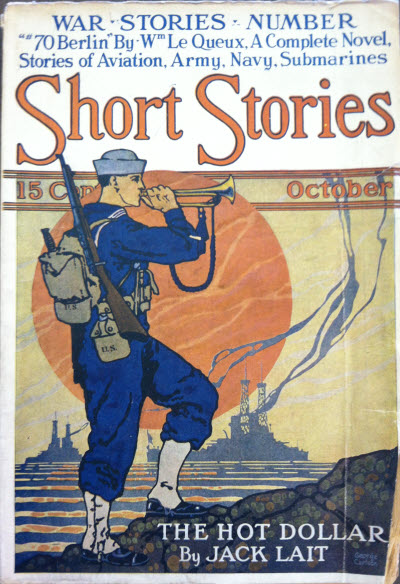
Short Stories, October 1917 cover - The first appearance of the red sun that i could find

We evolved the idea of the big red sun on our covers as a distinguishing mark, and we take pride and satisfaction in the thought of the millions of readers to whom that cheerful sphere has meant a promise of good stories, well told by the best writers in their respective fields, men who know the value of accuracy of detail as well as of an enthralling plot.

An unusual red sun cover from Short Stories August 1920, by J. H. Litchfield
And since nothing is constant but change, times have moved on, and under its present ownership SHORT STORIES has grown up with a new generation of readers. While other magazines have lowered prices, changed policies and turned some strange handsprings in a mad hunt for circulation, we feel that we have resisted those temptations and depended on reader- loyalty as the backbone of our progress.

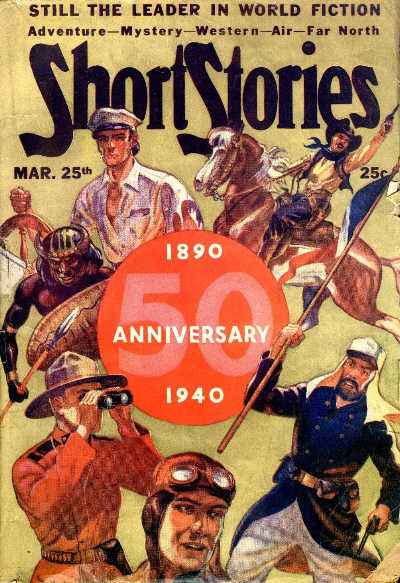
Short Stories March 25, 1940 issue cover by Edward M. Stevenson, editor Dorothy S. McIlwraith
In conclusion, a word about this present anniversary issue of SHORT STORIES. We wanted to make it as typical as possible of the magazine as a whole, we wanted to please as many of our multifarious readers as we could; so you’ll find in it old friends such as Black John Smith and Hopalong Cassidy—Hopalong was the almost universal choice for a reprint of an old favorite; newer friends such as the Hawkins twins and Caffrey’s airmen; and significant of the portentous days in which we live—a story of the present War. It’s by a man who is living very close to it at the present time and who has had many yarns in SHORT STORIES in the past—Major Gilson. We are sorry that there isn’t a Tuttle story in this number, but a perfectly grand one which introduces Hashknife to our friend Cultus Collins came along just too late to be included; it will appear soon in our pages. So —we leave with you this issue of your magazine, we hope you like it, and that you’ll all be with us for the next fifty years of SHORT STORIES.

The Editor.

Saturday, 18 November 2017

Swipe or inspiration - you decide


I saw a post on a Facebook group about an artist copying (swiping) a cover from a previous issue of another magazine, and i also heard that it was done many times. I decided to take a deeper look into this, you decide if it's swipe or inspiration. Leave comments with your thoughts.

Shadows at the waterhole (1907) by Frederic Remington vs. Adventure May 15, 1931 by L.F. Wilford

Adventure 1936 May cover  by Walter Baumhofer vs Short Stories Feb 25 1938 by A.R.Tilburne
Adventure 1936 May cover  by Walter Baumhofer vs Short Stories Feb 25 1938 by A.R.Tilburne

Adventure March 1 1932 cover by G.C. Delano vs Short Stories 19361225 by A. R. Tilburne
Adventure March 1 1932 cover by G.C. Delano vs Short Stories December 25 1936 by A. R. Tilburne

Adventure July 1934 cover by Walter Baumhofer vs Short Stories January 10 1937 cover by A. R. Tilburne

Adventure June 1 1931 cover by Remington Schuyler vs Short Stories March 25 1937  cover by A.R. Tilburne

Adventure May 1931 cover by Remington Schuyler vs Short Stories April 25 1937 cover by A. R. Tilburne
Adventure June 1934 cover by Walter Baumhofer vs Short Stories September 25 1937 cover by A. R. Tilburne

Adventure March 1936 cover by Hubert Rogers vs Short Stories April 10 1938 cover by A. R. Tilburne
Adventure November 10 1929 cover by Hubert Rogers vs Short Stories July 25 1938 cover by A. R. Tilburne
Adventure December 15 1930 cover by G.C. Delano vs Short Stories May 10 1939 cover by A.R. Tilburne

Adventure December 1939 cover by Wesley Neff vs Short Stories December 10 1943 cover by A. R. Tilburne

Adventure March 15 1928 cover by Dominic Cammerota vs Short Stories February 10 1946 cover by A. R. Tilburne
Interior illustration for Dusky by Jim Kjelgaard from Short Stories February 10 1946


And this last one has to be unique, the same artist on both sides

Adventure September 1941 cover by A. R. Tilburne vs Short Stories September 10 1944 cover by A. R. Tilburne

Saturday, 26 August 2017

Charles Richard Beeler aka Caddo Cameron - Cowboy, Railroader, Author

Charles Richard Beeler wrote under the pen name Caddo Cameron. He had many novels starring a pair of Texas Rangers – Blizzard Wilson and Badger Coe - in Short Stories, all of which were later issued in hardcovers. This was in addition to a series of stories about a pair of troublesome Texas twins – Paint and Pinto Hawkins. All worth reading, for he was one of those men who had witnessed the settlement of the American West, and could write with earthy humor about it.

Charles Richard Beeler aka Caddo Cameron (1881-19??)

Saturday, 15 July 2017

Robert H. Leitfred - Author

Robert Leitfred was an author working in many different genres from aviation and war at the beginning of his career (the early 1930s) and moving to detective, speculative/weird fiction and general adventure fiction in the 1940s. He wasn’t a prolific author – close to a hundred stories in the Fictionmags index, and biographical details are thin on the ground. What I have here is a skeleton of the bare facts; hopefully someone can fill in more details later.

Robert H. Leitfred (1891-1968) - Author photo c. 1918

Saturday, 11 March 2017

Ray Millholland – Engineer, Sailor, Author

Ray Millholland is pretty unknown today. Back in the day, he was famous for a series of stories in the Saturday Evening Post about a master machinist named Blue Chip Haggerty. Blue Chip is a master machinist who gets into a jam, and then out again while trying to meet the rigid specifications of the Army and Navy. These stories were later collected in a book. He’s also famous for his book on the splinter fleet of submarine chasers in World War 1, The Splinter Fleet of the Otranto Barrage, which was later made into a movie. I’m writing this article as part of a series about the authors in an issue of Short Stories that I’ll get around to reviewing soon.

Ray Milholland - Author (1894-1956) - Image courtesy Library of Congress

Saturday, 4 March 2017

Alfred Batson – Soldier, Journalist, Author

Starting a new series of biographical articles about some authors who appeared in Short Stories magazine. I intend to review an issue of Short Stories where these authors had appearances, and in the process of reviewing the magazine, also took the time to unearth some biographical info about them. 

The first author in this series is Alfred Batson, who turned out to be quite an interesting character. He started appearing in pulp magazines in the early 1930s and continued till the early 1940s.
Alfred Batson (1899-1977) - Soldier, Journalist, Author

Saturday, 18 February 2017

Berton E. Cook - Sailor, Teacher, Author

This article is dedicated to Matt Moring, the man behind the curtain at Altus Press, the publisher that is putting out a remarkable series of pulp reprints. Last time we met, we had talked about needing biographical information on this author. Here it is, Matt; only took around half a year.

Berton E. Cook (1889-1958) - Author, Sailor, Teacher Photo c. 1948
Berton E. Cook (1889-1958) - Author, Sailor, Teacher
Photo c. 1948

Saturday, 31 December 2016

Holman F. Day - Newspaperman, Novelist, Poet

Holman Day was an author who appeared in “Blue Book”, “Short Stories” and “The Popular Magazine”. I found a biographical article about him in the Lewiston Journal Sunday Magazine, January 18, 1969. It started with a reference to his home. I found a picture of it on Google maps, looks amazing. The interiors look even more amazing - take a tour of the house here.


Holman Francis Day, Author (1875-1935)


Sunday, 30 October 2016

Dee Linford - Western Author, Journalist, Technical Writer

Dee Linford is not a well known author today, remembered if at all as the author of the story Man Without A Star, which was made into two movies, Man Without A Star (1955), A Man Called Gannon (1968), and an episode of a TV series, The Virginian, in 1963.

He wrote a series of stories about Sudden John Irons, a range detective. I liked a couple of stories of his in Short Stories magazine, especially Dead Man’s Dome in the August 25, 1948 issue. It begins with this passage:
CHAPTER I
FUGITIVE TOWN

THE sign was a crudely lettered shingle, nailed to the trunk of the only tree in sight. "Welcome to Wildcat,” it bade the stranger—expressing in three short words the whole timeless spirit of friendly optimism on which such towns are founded. But the town itself was nowhere in sight.

Stub Williams, so called because of his unusual angular height, sat hunched on the spring seat of his high-bedded wagon, looking at the sign and at the sentinel cottonwood which rose like a skeleton above the rubbish-littered flat. Weighing a problem in his mind.

The sign was in the right. The sign had to be in the right. The map the saloonman had sketched for Stub in Casper had placed the town squarely between the forks of Deadman Creek, here on the Poison Spider Plains.

Well, Stub was sitting within sight of Big Deadman, to his right, and Dry Deadman, to his left. And there was the sign welcoming him to town. The rubbish scattered around showed the town had been there, no more than a week before. But the town, clearly, was not there today.

The whole setup was baffling, and slightly eerie. Stub rubbed the back of his sunburned neck and looked quickly behind him, as if expecting to find the missing community of five thousand souls stalking him from the rear. But he saw only the bleaching bones and rusty tin cans. The heaps of whiskey bottles where the saloons had stood. The fly-crawling refuse and charred debris of what once had been a thriving town. A town where Merrybelle had lived, wanting to have a well sunk.

How can you not go reading on after that? I did; it's a story of a rich man dominating an entire town, with a stranger riding in to rescue the exploited townsfolk, a theme to which Dee returned many times.
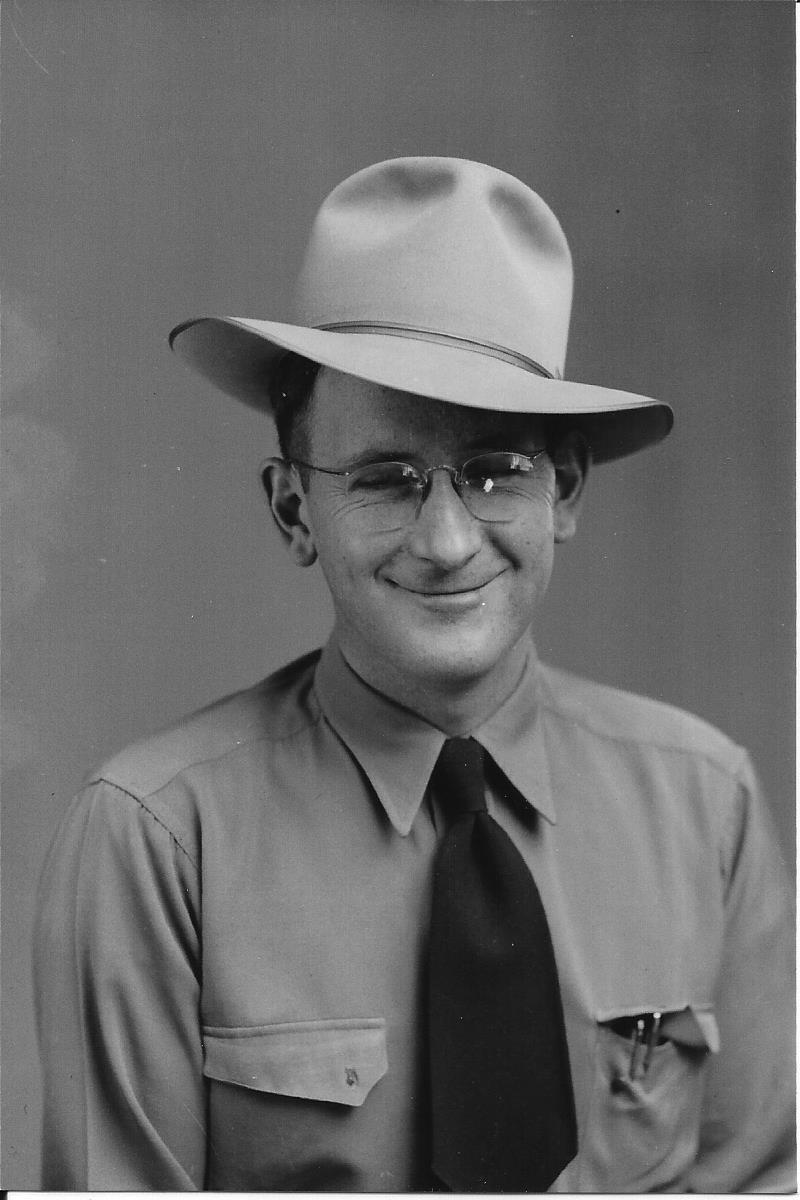
DeVerl (Dee) Linford, pulp western author (Undated photo courtesy FamilySearch,org)

Deverl (Dee) Hess Linford was born on March 3, 1915 in Afton, Wyoming, a town on a section of the Oregon trail bordering Idaho and Utah, in a grassland valley surrounded by forested mountains. His parents were Joseph Linford and Sarah Hess, both of whom had English and Utahn parents. Joseph Linford had earlier studied at Brigham Young University and moved to Afton where he homesteaded a ranch and worked in the dairy business. This history and backdrop was later used by Dee Linford in some of his stories.

Dee went to the Star Valley High School in Afton, where he was a scholarship student. In 1932, he gave the salutatory address at his high school graduation.

Star Valley High School (Picture courtesy the Kennington and Weber Families blog)
Star Valley High School (Picture courtesy the Kennington and Weber Families blog) 

After that came the University of Wyoming, Laramie where he studied journalism. He worked briefly on the Laramie Republican-Boomerang. In 1934, he married Helen Grace Bagley, also from Afton. She was in the class that graduated one year after he did. They moved to Cheyenne, Wyoming, where he became the editor of the Wyoming Wildlife magazine, published by the Wyoming Game and Fish Commission. In 1938, he was also assisting in the preparation of the WPA Guidebook to Wyoming, Wyoming: a Guide to its History, Highways, and People.

I came across a newspaper report from 1939 that says he had sold his first two stories for $200. His first stories appeared in Dime Western in early 1940, according to the FictionMags index, so this feels right.

In World War 2, Dee served as on the U.S.S. Neshoba, an attack transport ship that operated in the Pacific theatre of war from 1944 to 1946, participating in the battle of Okinawa, travelling from Guam and Saipan to Seattle and San Francisco with POWs and soldiers.

Photo of U.S.S. Neshoba courtesy PriorService.com

During this time, his output dropped to a couple of western stories a year, still an impressive feat considering the conditions he was working under. He didn’t start writing about his war experiences or setting some stories in the area, unlike other writers.

Sometime in the very late 1940s or early 1950s, the Linfords moved to Socorro, New Mexico. Helen joined the New Mexico Institute of Mining and Technology as a professor of mines. Dee went to work in the publications office of the University before becoming a technical writer and editor in the New Mexico State Engineer’s office. It was just as well they did this, the pulp magazine market was collapsing in the early 1950s and they must have financially benefited from the move.

In 1952, Dee published the book “Man without a star” that was subsequently made into the Kirk Douglas starrer, Man Without A Star. The movie has another pulp connection; one of the screenplay authors was Borden Chase, a writer who had moved to California as a studio writer.

Poster for Man Without A Star (Courtesy FilmAffinity.Com)
This book seems to have been the last of his writing career; I can’t find any records of either books or magazine articles/stories written by him after 1952.

In 1954, Helen died unexpectedly of a cerebral hemorrhage, leaving Dee to raise their four children. Dee passed away on August 20, 1971 after a long illness. His papers are at the University of Wyoming’s American Heritage Center.

Wednesday, 29 July 2015

In honor of International Tiger Day


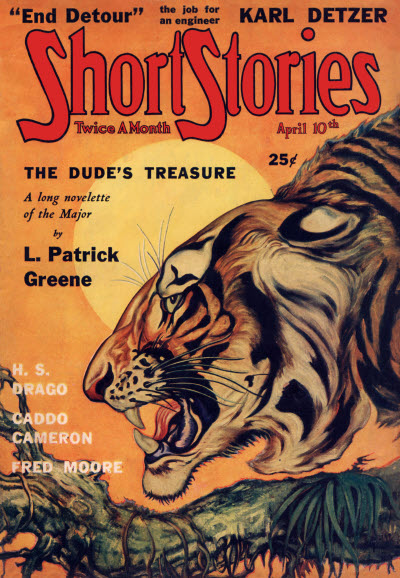
Short Stories April 10, 1946

A wonderful cover by A. R. Tilburne, and stories from Dan Cushman, Caddo Cameron and Wilbur S. Peacock - all great authors. This is one I have.


Some more tigers from the same artist and same magazine:


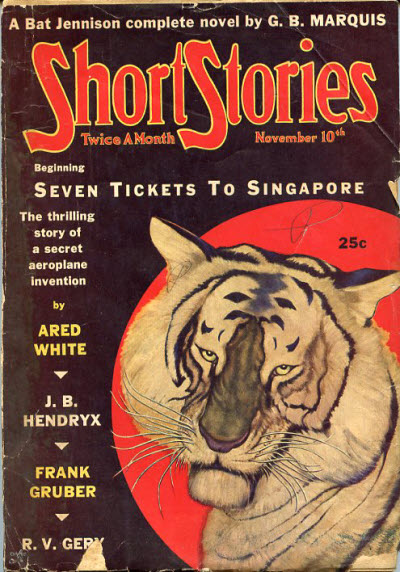
Short Stories, November 10, 1938


Short Stories, April 10th, 1939
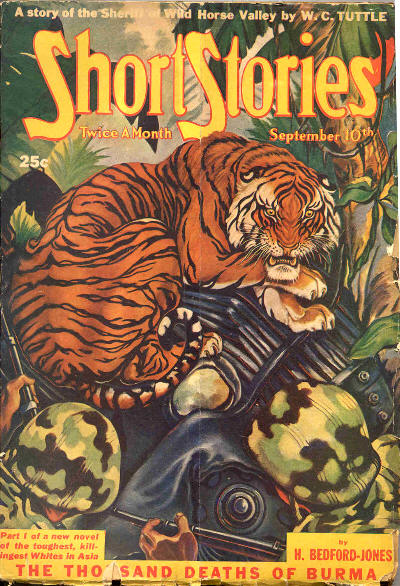
Short Stories, September 10, 1944
 
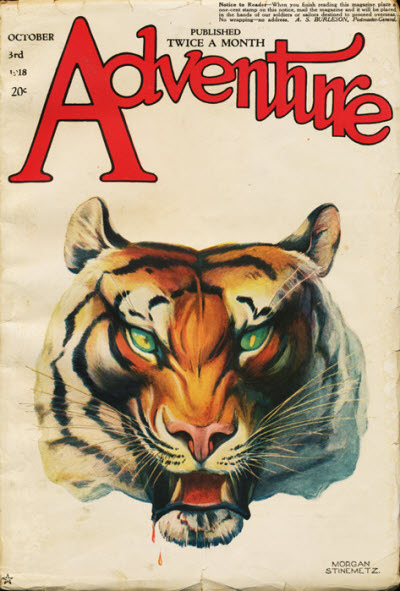
Adventure, October 3, 1918


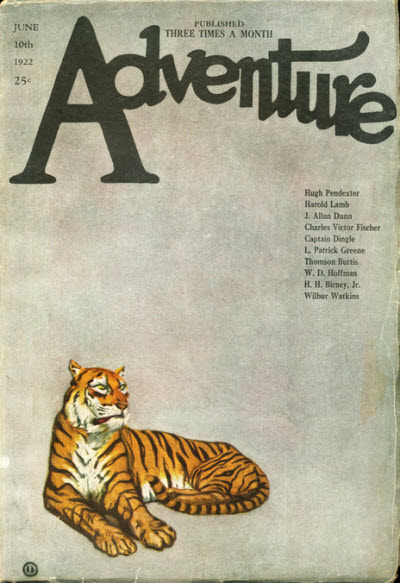
Adventure, June 10th, 1922

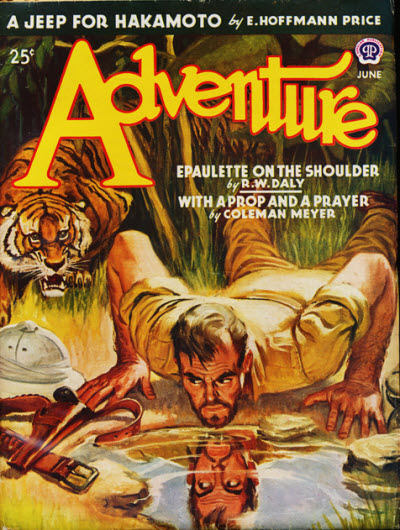
Adventure, June 1946
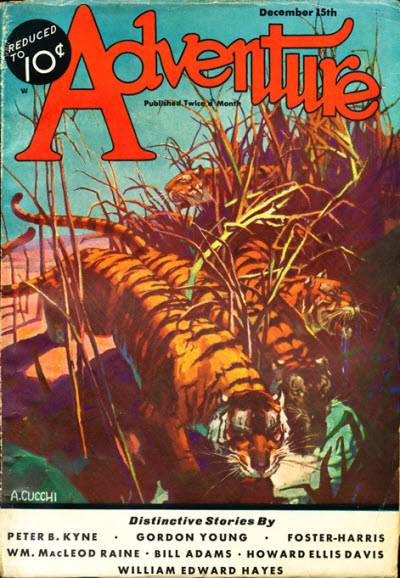
Adventure, December 15, 1932
Adventure, December 15, 1932 
 
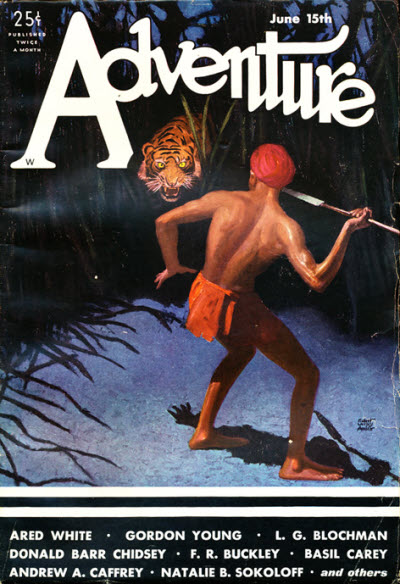
Adventure, June 15th, 1932
 
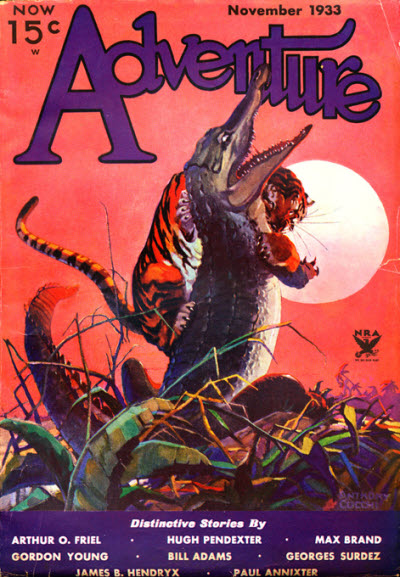
The most unlikely one:
Adventure, November 1933
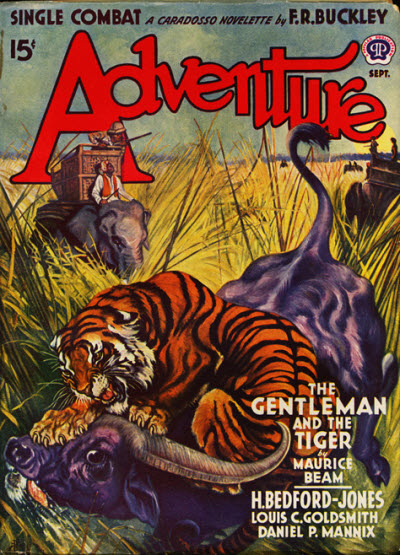
And to round it all off, another tiger cover from A.R. Tilburne:
 
Adventure, September 1941
 
Pick your favorite and tell us why in the comments,
or share your personal favorite tiger cover.
 
 
Bonus: The prize winner
Weird Tales, April 1933