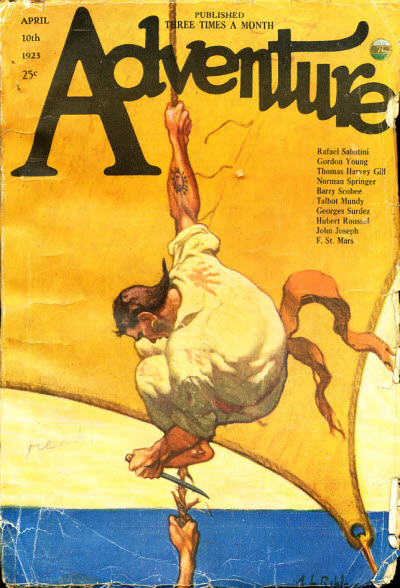
Ray Millholland is pretty unknown today. Back in the day, he was famous for a series of stories in the Saturday Evening Post about a master machinist named Blue Chip Haggerty. Blue Chip is a master machinist who gets into a jam, and then out again while trying to meet the rigid specifications of the Army and Navy. These stories were later collected in a book. He’s also famous for his book on the splinter fleet of submarine chasers in World War 1, The Splinter Fleet of the Otranto Barrage, which was later made into a movie. I’m writing this article as part of a series about the authors in an issue of Short Stories that I’ll get around to reviewing soon.
Showing posts with label Adventure. Show all posts
Saturday, 11 March 2017
Sunday, 30 October 2016
Dee Linford - Western Author, Journalist, Technical Writer
Dee Linford is not a well known author today, remembered if
at all as the author of the story Man Without
A Star, which was made into two movies, Man
Without A Star (1955), A Man Called
Gannon (1968), and an episode of a TV series, The Virginian, in 1963.
He wrote a series of stories about Sudden John Irons, a
range detective. I liked a couple of stories of his in Short Stories magazine, especially Dead Man’s Dome in the August 25, 1948 issue. It begins with this
passage:
CHAPTER I
FUGITIVE TOWN
THE sign was a crudely
lettered shingle, nailed to the trunk of the only tree in sight. "Welcome
to Wildcat,” it bade the stranger—expressing in three short words the whole
timeless spirit of friendly optimism on which such towns are founded. But the
town itself was nowhere in sight.
Stub Williams, so
called because of his unusual angular height, sat hunched on the spring seat of
his high-bedded wagon, looking at the sign and at the sentinel cottonwood which
rose like a skeleton above the rubbish-littered flat. Weighing a problem in his
mind.
The sign was in the
right. The sign had to be in the right. The map the saloonman had sketched for
Stub in Casper had placed the town squarely between the forks of Deadman Creek,
here on the Poison Spider Plains.
Well, Stub was sitting
within sight of Big Deadman, to his right, and Dry Deadman, to his left. And
there was the sign welcoming him to town. The rubbish scattered around showed
the town had been there, no more than a week before. But the town, clearly, was
not there today.
The whole setup was
baffling, and slightly eerie. Stub rubbed the back of his sunburned neck and
looked quickly behind him, as if expecting to find the missing community of
five thousand souls stalking him from the rear. But he saw only the bleaching
bones and rusty tin cans. The heaps of whiskey bottles where the saloons had
stood. The fly-crawling refuse and charred debris of what once had been a
thriving town. A town where Merrybelle had lived, wanting to have a well sunk.
How can you not go reading on after that? I did; it's a
story of a rich man dominating an entire town, with a stranger riding in to
rescue the exploited townsfolk, a theme to which Dee returned many times.
| DeVerl (Dee) Linford, pulp western author (Undated photo courtesy FamilySearch,org) |
Deverl (Dee) Hess Linford was born on March 3, 1915 in
Afton, Wyoming, a town on a section of the Oregon trail bordering Idaho and
Utah, in a grassland valley surrounded by forested mountains. His parents were
Joseph Linford and Sarah Hess, both of whom had English and Utahn parents. Joseph
Linford had earlier studied at Brigham Young University and moved to Afton where
he homesteaded a ranch and worked in the dairy business. This history and backdrop
was later used by Dee Linford in some of his stories.
Dee went to the Star Valley High School in Afton, where he
was a scholarship student. In 1932, he gave the salutatory address at his high
school graduation.
![]() |
| Star Valley High School (Picture courtesy the Kennington and Weber Families blog) |
After that came the University of Wyoming, Laramie where he
studied journalism. He worked briefly on the Laramie Republican-Boomerang. In 1934, he married Helen Grace Bagley, also
from Afton. She was in the class that graduated one year after he did. They
moved to Cheyenne, Wyoming, where he became the editor of the Wyoming Wildlife magazine,
published by the Wyoming Game and Fish Commission. In 1938, he was also assisting
in the preparation of the WPA Guidebook to Wyoming, Wyoming: a Guide to its History, Highways, and People.
I came across a newspaper report from 1939 that says he had
sold his first two stories for $200. His first stories appeared in Dime Western in early 1940, according to
the FictionMags index, so this feels right.
In World War 2, Dee served as on the U.S.S. Neshoba, an
attack transport ship that operated in the Pacific theatre of war from 1944 to
1946, participating in the battle of Okinawa,
travelling from Guam and Saipan to Seattle and San Francisco with POWs and
soldiers.
| Photo of U.S.S. Neshoba courtesy PriorService.com |
During this time, his output dropped to a couple of western stories
a year, still an impressive feat considering the conditions he was working
under. He didn’t start writing about his war experiences or setting some
stories in the area, unlike other writers.
Sometime in the very late 1940s or early 1950s, the Linfords
moved to Socorro, New Mexico. Helen joined the New Mexico Institute of Mining
and Technology as a professor of mines. Dee went to work in the publications
office of the University before becoming a technical writer and editor in the
New Mexico State Engineer’s office. It was just as well they did this, the pulp
magazine market was collapsing in the early 1950s and they must have financially
benefited from the move.
In 1952, Dee published the book “Man without a star” that
was subsequently made into the Kirk Douglas starrer, Man Without A Star. The movie has another pulp connection; one of
the screenplay authors was Borden Chase, a writer who had moved to California
as a studio writer.
| Poster for Man Without A Star (Courtesy FilmAffinity.Com) |
This book seems to have been the last of his writing career;
I can’t find any records of either books or magazine articles/stories written
by him after 1952.
In 1954, Helen died unexpectedly of a cerebral hemorrhage, leaving
Dee to raise their four children. Dee passed away on August 20, 1971 after a
long illness. His papers are at
the University of Wyoming’s American Heritage Center.
Monday, 19 September 2016
Adventure magazine covers featuring a pirate
In honor of International Talk like a Pirate Day today, here's a series of covers from Adventure magazine featuring a pirate. All these covers were done by the artist A.L. Ripley and appeared in the magazine from 1922 to 1925. During at least part of this period (1923-1925), Ripley was in Europe on an art scholarship, so it's interesting to speculate whether these were done in Europe and sent over, or done in bulk earlier and then appeared one at a time.
Pick your favorite and leave a note in the comments. Mine's the March 10, 1924 issue with the two pirates shown in shadow fighting over treasure.
|
|
|
|
|
|
|
|
|
|
|
|
|
|
|
|
|
|
|
|
Saturday, 18 June 2016
Behind the scenes - how the editorial office worked at Adventure magazine
[This article from Arthur S. Hoffman originally appeared in the February 1, 1927 issue of Adventure magazine. I thought it was an interesting behind the scenes look at how the magazine worked.
If you worked on a magazine, let us know what you saw.]
LOOKING ABOUT
IT MAY be that some of you think our asking so often for
your suggestions on the making and shaping of our magazine is only an empty
performance. Here is exactly what is done in the office:
First, there are your letters that come in because of no
specific request made to you but merely as a result of the general reader
interest in our magazine, of the friendly, active, we-are-part-of-Adventure feeling that has grown up
through the years. Those letters are read word for word. One editor is
especially assigned to the duty of keeping an exact card-index record of every
single comment on any of our writers or any of their stories, even a mention of
such, favorable or unfavorable. Every six months he makes out a carefully
tabulated, detailed report, ranking our whole list of authors on the basis of
our readers’ ‘Votes.” Every member of the staff pores over that report.
Allowance must be made for the number of times an author
appears during the six months’ period covered, for serials or novelettes versus
shorts, and so on. But the ranking of authors from that summary of readers’
votes becomes at once a guide in the buying of manuscripts during the next six
months. Also it brings about a new assessment of our writers as to their
relative values to this particular magazine and consequently as to the rate of
payment each should have.
General comments on other phases and features of our
magazine are not card-indexed. The multiplicity and variety of points commented
upon, from typographical details to the general policy of the magazine, make
this impracticable. But it is the duty of the editor in charge to note down any
pronounced amount of comment on any one point and, if comment continues heavy,
to begin tabulating “votes” on that point, meanwhile of course calling the
attention of the rest of us to the point on trial.
Comments on any particular department—"Camp-Fire,” “Ask
Adventure,’’ "Information services", “Travel,” “Straight Goods,”
“Books,” “Old Songs,” “Lost Trails,” “Trail Ahead,” “Looking About” —are turned
over to the editor in charge of that department, to be read, summarized, filed
or used in his department.
Any reader’s letter claiming one of our authors has been
inaccurate or incorrect in the use of any of the fact material in his fiction,
or any of ourselves or our service editors in anything printed in the magazine,
gets particular attention. If a final verdict on the claim, for or against, can
not be authoritatively given in the office, the letter is mailed or turned over
to the author or editor involved and it’s up to him either to confess error or
to convince the reader the criticism was not soundly taken.
The results in this case are apparent. Adventure prides
itself on an earned reputation for accuracy and reliability in the local color,
setting and atmosphere of its stories, in all fact material, historical or
otherwise, used in its fiction. It wasn’t the editors who earned that reputation
for our magazine. It was the readers who earned it. And they did it by the
method above. No set of editors in the world could be final authority on all
the subjects and places covered, but, whatever the subject, there are always at
least a few among our readers who are very competent authorities. Writers and
editors have learned that it is not healthy to come before Adventure's audience
with fact material that isn’t bullet-proof. None of us is infallible, but when
we slip we acknowledge it frankly in type so that there can be no uncorrected
misinformation laid before our readers.
Another result is interesting topics, investigations and
discussions for Camp-Fire. Will older readers ever forget the argument royal
that arose among Camp-Fire over Talbot Mundy’s interpretation of the character
of Julius Caesar in the Tros stories? Had to stop it finally because it wasn’t
leaving space for much else, but I think most of us learned more about Julius
Caesar than we had ever known before. We’re still getting occasional requests
to have the contributions to that argument issued in book form. Well, maybe we
can some day.
Of such results as the above you will be finding plenty of
proof in the magazine as you go along, but another result is not so obvious.
Nearly all the comments and criticisms are in friendly spirit and the replies
are in kind. Therefore in hundreds and hundreds of cases real personal
friendships have grown up between readers and writers, or among readers, and
the real fellowship of Camp-Fire is very appreciably promoted.
All the foregoing applies to general letters from readers.
Your letters not read? All of them are read. At the top of some will be
penciled three or four names— authors or editors—which means that the owner of
each name must see that letter.
As to opinions on specific points, specifically asked for.
Well, take the request for readers’ suggestions and advice on the new form of
our magazine.
The response from readers in this case has been splendid.
Our summary of your suggestions has now been put into final and complete form.
Not only has every one of the active editorial staff studied it thoroughly but
carbon copies have been passed on to each of the following for his equally
careful study—the publisher, the assistant publisher, the heads of the
Circulation and the Promotion Departments.
We’re going to give you an exact copy of that report in
full. With one exception. Some of the information you have given us is much too
valuable and important to broadcast for the benefit of other publishers.
Accordingly in at least one place we’re going to scramble the report a little,
but any such places, and the nature of the scrambling, will be indicated for
your benefit. Other publishers of course get an occasional formal referendum
from readers, get questions for specific answer. No other magazine gets from
its readers anything like such a response of voluntary, independent opinions
and suggestions as Adventure’s readers give to it. We do not see why we should
hand over to other magazines all of the valuable information thus received,
information meant for us, not for them.
I think we can give you the report in “Camp-Fire” of the
issue following this one. If not, as soon as it can be done.
And to the very sincere thanks of my own department I am to
add those of all the other departments cooperating in making Adventure a magazine that meets the
desires of the majority of its readers as closely as is humanly possible to do.
Oh yes, we really want your suggestions and criticisms! And
we really read and consider them when we get them. If you don’t like this or
that in the magazine, tell us so. We can’t please everybody on every point, but
we can please the majority and so far as it’s at all possible we naturally want
to do just that.
Lots of people never write to any magazine about anything.
But this is different. Adventure isn’t
just a magazine. It’s Camp-Fire, readers, writers and editors working together
to make for themselves the best magazine and clearing-house of ideas and
information that they can, and to have as good and friendly a time as possible
while they’re doing it. Do your part. Don’t just take from the rest of us
without contributing your share in return. There’s always a bit of time now and
then when a letter or post-card and a few marks with pen, pencil or typewriter
can send in a criticism or suggestion that may bear good fruit for all who
gather around the Fire. You’re not writing to a magazine—you’re writing to Adventure.—a. s. h.
Saturday, 30 April 2016
Tom Curry - Author, Engineer, Sportsman
[This article originally appeared in the Hour, a Norwalk, CT, newspaper on November 24, 1971]
![]() |
| Thomas A. Curry aka Tom Curry, Author |
Tom Curry, a long-time Norwalk resident, sold his first fiction story at 20 while studying chemical engineering at Columbia College in 1920, and within a year’s time the talented young student was writing for a half-dozen of the more popular "pulp” magazines—mainly Western fiction. And for over 50 years, bold, fearless heroes who virtually sprung to life in the thrilling pages of his stories— such as the Rio Kid and his horse, Saber, who rode the dangerous frontier trails in search of ruthless outlaws and evil doers; Walt Slade, whose iron fists and blazing six-shooter spread terror among the toughest badmen; courageous Texas Rangers, hard-riding, fast-shooting men, ever ready to face any outlaw’s vengeance in patrolling the dangerous border area between Texas and Mexico; Ranger Riders, super-heroes of the early West, among them many of the toughest, roughest, most memorable characters who ever roamed the frontier, men who had to ride hard and shoot fast and straight in order to survive; and many others who gambled their lives in the winning of the West, back in the legendary era following the Civil War, when the Plains Indians, said to have been the world’s greatest horsemen, donned their war paint to hunt the white-skinned invader—have thrilled his many readers.
For a half-century the well-known local author has been steadily contributing to the "pulps, ” turning out between 500, 000 and 600, 000 words a year regularly. He has sold all types of stories—including detective, sports, adventure, fantasy, science—you name it, he has written it. He has also appeared in magazines such as Collier’s, American Home, The Elks, St. Nicholas, The American, McClure’s, and many others, literally hundreds of periodicals. Several hundred hardcover and paperback books have appeared under his byline and under several of his pen names (such as "Jackson Cole” and "Bradford Scott") for professional purposes. In his career Mr. Curry would often have three or four hardcover or paperback books, or a half-dozen or more full-length stories in pulp magazines, appearing in print under three or four different names, in the same month. But his real signature, Tom Curry, appears on the majority of his more than 175 novels and countless hundreds of magazine feature stories.
Born in Hartford on Nov. 4, 1900, Mr. Curry has resided in the Cranbury section of Norwalk for most of the past 50 years. He and his wife, the former Louise Moore of New York city, live in one of Norwalk’s oldest houses a big, attractive Colonial farmhouse with hand-hewn chestnut beams and a large, old-fashioned fireplace with a Dutch oven.
At Columbia, Mr. Curry was a member of the varsity water-polo team and he has never lost his love of swimming, spending almost every summer afternoon at the beach. For 20 years he played tennis during the summer months, and during those two decades was equally well-known on Norwalk and Westport tennis courts as a star competitor. In fact, back in the 1930s, he and Bob Carse, who was also a well-known local fiction writer, after winning practically every tournament in the county, climaxed the season by taking the men’s doubles championship in the Nassau Invitation Tennis Tournament. During the winter months, Mr. Curry performed on the badminton courts—also being of championship ranking at that sport. Now he is playing ping-pong, a game at which he also excels.
As a young boy, Mr. Curry was virtually surrounded by successful writers in his family. In 1914 his father sold what turned out to be a profitable ploy, "Just The Same As Now, " to David Belasco, the famed producer, Mr. Curry’s mother also was a noted playwright, and his sister was married to a noted author, F. R. Buckley.
"My brother-in-law had never been west of Philadelphia in his life, but he wrote some of the best Western stories, some of the greatest action fiction I've ever read. One, 'Gold Mounted Guns’, won the 1922 O' Henry prize and is included in many anthologies and textbooks. For years he was a regular contributor to Western Story and other top pulp magazines.
"With all these shining examples to inspire me, I decided to try my own hand at fiction-writing, and was fortunate to have it accepted by A. L. Sessions, editor of People’s, one of the Street & Smith's numerous pulps. He sent me $25 and I was naturally puffed with pride. "
Mr. Curry studied chemical engineering at Columbia for three years. Then, at 23, he accepted a job as crime reporter-working from 6 P. M. to 3 A. M. —for the old New York American.
"I got to know a number of police detectives, often accompanying them when they went out to make investigations or arrests, " he reflected. "It was on a first name basis with practically every cop on the night- shift boats. It was heady stuff for a youth, constantly making the rounds of the various police precincts, but I soon quit. "
"I felt I was a free-lance writer at heart and wanted more. " "During the 1920s the fiction field was flourishing... vigorously thriving... with a steady, ever-flowing source of material that was being readily consumed by dozens of publishers, both hardcover, paperback and magazine. I wrote a number of detective stories, and Black Mask Magazine bought one. Soon I became one of Editor Joe Shaw’s regular contributors, and my name began appearing in distinguished company—Dashiell Hammett and Erle Stanley Gardner being among the many authors writing for Shaw at the time. "
During the period when Mr. Curry covered the night-beat as a police reporter on the old New York American, he saw firsthand the incessant flow of daily life that comprises a great metropolis such as New York city, and from his vast experience gained in accompanying detectives and policemen on their various nightly assignments, he acquired invaluable knowledge that gave him the background to successfully produce hundreds of detective fiction stories for numerous pulp magazines during the 1920s and 1930s. During that "Golden era” for fiction-writers, he also sold hundreds of action-packed Western stories, historical articles and short stories.
For several years after leaving the N. Y. American, Mr. Curry and his wife traveled extensively throughout the Western United States as well as in a number of foreign countries before settling for six months in Bermuda, "living in a coral cottage by the sea. ” Known by his many publishers as a talented, dependable, prolific author, his stories, compiling an amazing total of over 500, 000 words a year, were readily accepted.
"During that lucrative period... an era that is frequently called the 'Golden Age' of the magazine... when it seemed almost impossible not to sell a story... new magazines popped up almost every week and In a short time had a circulation of 250, 000 or above. It seemed fantastic, but there were so many pulps and smooth-paper periodicals you could scarcely keep track of them all. Incredible numbers of stories were required, and editors couldn’t be too picky. It was truly a writer's paradise! "
And Mr. Curry successfully wrote for a great number of publications. He branched out, with his byline appearing as often in the smooth-paper magazines as it did in the pulps—among them being Argosy, G-Men, Thrilling Adventure, Blue Book, Black Mask, Popular Western, Detective Fiction, as well as the Rio Kid Western, Thrilling Western, Range Riders, Texas Rangers and numerous others.
Many of these weekly or monthly Western publications confined their stories to the period following the American Civil War, during the time when real historical characters such as Wyatt Earp, Buffalo Bill, General Custer, Calamity Jane, Bat Masterson, Bill Hickock, Quanah Parker, the Comanche Chief, and many others roamed the treacherous trials of the great Western frontier throughout New Mexico, Arizona, Nevada, Montana, Colorado, Texas, etc in The Rio Kid Western, for many years a popular historical Western publication owned and published by Thrilling Publications, whose chief editor was the famed Leo Margulies (who was a frequent visitor in Norwalk, his uncle at one time having owned and operated a business on Washington street). Thrilling Publications published some 50 periodicals - Westerns, Detective, mystery, all combat, spy, sports etc.
The Rio Kid was the hero of an exciting adventure in every monthly issue of the magazine named for him. An ex-cavalry officer who had served under General Custer, he constantly—as the brave young hero confronting the ruthless villain—came into contact with those other well-known heroes along the Western trails, and were relived.
For years Mr. Curry wrote fast-action thrillers involving the Rio Kid as well as the Texas Rangers. "The general theme must be that the hero, being young, handsome, strong, personable, and endowed with great moral courage and character, as well as being an expert shot, fist-fighter, cowpuncher and rider, must, in willingly facing the most hazardous missions, track down, confront and defeat the villain in violent physical combat. The outlaw, whose ruthless designs threaten the very existence of the hero and those he loves, is not only a dangerous killer but is equally as skilled both in handling a six-shooter and riding a horse. And the nerveless villain, with many notches in his blazing guns, who invariably has joined forces with other equally infamous renegades and notorious bad-men, must get his just due. The fearsome bandits and robber gangs, stealing the gold, rustling the cattle, or holding up the stage coach, must not be successful in escaping justice after having carried out their devious plans. And, like all romantic adventure stories, these yarns must have a happy ending, as far as the hero is concerned, that is. ”
Maintaining his tremendous deadline schedule keeps Mr. Curry constantly busy figuring out fresh, new "plots, ” always thinking, pondering, planning the motivating phases of action which fit into the basic outline of the story he is writing. Saying that he has always found writing to be a most pleasurable occupation, he explained that for many years he was able to turn out the finished manuscript of a full-length book or magazine story in the short period of but two to four weeks, working at his typewriter for five or six hours a day, seven days a week, including holidays.
And which of your many fictional heroes is your favorite character?
“One of my all-time favorites has to be the Rio Kid, ” he said. "Of course I'm very fond of all of them. "
In considering your sudden change of plans in regards to your life’s profession while a student at Columbia College, have you ever regretted it?
"No, absolutely not, " he admitted. "I've had a great many years of pleasure being a somewhat successful fiction writer, " he continued, "and I can honestly say that I'm very proud of having my name associated with the truly distinguished company of Western chroniclers and historians. "
Many of the novels that Mr. Curry has written remain in print today. And as each succeeding generation continues to find adventure and reading excitement in his numerous stories, the majority of which are thrilling Western yarns of fast-riding men with blazing guns, of lost mines and hidden treasures, invariably set in a background of purple sagebrush, blinding desert heal and dust, the reader can almost feel himself squinting into the bright crimson sunset. Exciting epics of fiery action, of great American heroes who gambled their lives in the winning of the West.
But what happened to the magazine publishing business when the Great Depression hit?
"It was a very difficult time... beginning about the mid-’30s. There was great rivalry for the writing dollar, and the pulp market had virtually collapsed... why, within the space of a few months' time even the best-selling magazines hit a low slump. The bottom literally fell out of the market. "
Mr. Curry has traveled extensively in and intimately knows the old West about which he writes. A top literary critic reviewing one of his Western novels for a New York newspaper in 1951 said, "You'll find in any Tom Curry western story a true picture of the West that was and is no more.”
Mr. Curry says he is especially proud of his "Famous Figures Of The Old West". This contains 60 short biographies of heroes and villains of the Western Frontier. The book is beautifully illustrated by Wood Cowan, a long time resident of Weston, who, as a member of Newspaper Enterprises of America (NEA), drew popular syndicated features for many years, one being the widely- distributed cartoon known as "Major Hoople. " "The Buffalo Hunters, " one of Mr. Curry’s best-known novels is being published as a paperback, and there are several new stories that will soon appear on the racks, some by "Jackson Cole" (Mr. Curry’s pen-name used by the publishers on all Curry novels appearing in Texas Rangers Magazine). From 1936 to 1950, Mr. Curry wrote 85 of these lead stories.
Recently he sold a "Walt Slade" Western, which will be under the byline, "Bradford Scott. " Walt Slade was created by Leslie Scott, a well-known writer and long-time close friend of Mr. Curry who has turned out some 100 of these paperback Westerns, for Pyramid Books.
In 1951, after the magazine market had collapsed ("Television had delivered the knockout punch to the general fiction field"), Mr. Curry accepted a position with Dorr-Olivcr, Inc., an engineering firm in Westport, and stayed with them for 14 years. In 1964 he again turned to free-lance writing full-time—Western novels plus articles on a variety of subjects. He was soon turning out some 500,000 words a year, mainly in hardcover and paperbacks and a few pulp magazines still remaining on the stands, though the latter market had changed drastically, with little fiction being used and articles being basically in demand.
Beside a number of fiction stories of Zane Grey Western Magazine, Mr. Curry also has recently sold several true historical pieces, one titled ". Secret of the Little Big Horn, " concerning Custer’s famous last stand, and a short biography of the famous author, Zane Grey.
Now, after 50 years of turning out a constant flow of novels, short stories, historical features and science articles, Mr. Curry says it is time that he "slowed down a bit. " He and his wife, who recently retired after 20 years with the Famous Schools in Westport, plan to head south this winter to escape the snow and cold. Mr. Curry has been a prominent member of Western Writers of America for half a century, and this past June, he and his wife attended the WWA convention held in Santa Fe, New Mexico, with many other well-known authors.
His current novel, "Gunfighter’s Holiday" (Avalon Books, 1971), may be found on local library shelves, while a second novel, "Colorado River Gold. " is scheduled for publication in December.
Mr. and Mrs. Curry have a son. Dr. Stephen J. Curry, who graduated from Norwalk High School, Columbia University, and the University of Wisconsin. He is a professor of English in a college in upstate New York. Mr. and Mrs. Curry also have a grandson, Geoffrey S., age 10.
For a half-century the well-known local author has been steadily contributing to the "pulps, ” turning out between 500, 000 and 600, 000 words a year regularly. He has sold all types of stories—including detective, sports, adventure, fantasy, science—you name it, he has written it. He has also appeared in magazines such as Collier’s, American Home, The Elks, St. Nicholas, The American, McClure’s, and many others, literally hundreds of periodicals. Several hundred hardcover and paperback books have appeared under his byline and under several of his pen names (such as "Jackson Cole” and "Bradford Scott") for professional purposes. In his career Mr. Curry would often have three or four hardcover or paperback books, or a half-dozen or more full-length stories in pulp magazines, appearing in print under three or four different names, in the same month. But his real signature, Tom Curry, appears on the majority of his more than 175 novels and countless hundreds of magazine feature stories.
Born in Hartford on Nov. 4, 1900, Mr. Curry has resided in the Cranbury section of Norwalk for most of the past 50 years. He and his wife, the former Louise Moore of New York city, live in one of Norwalk’s oldest houses a big, attractive Colonial farmhouse with hand-hewn chestnut beams and a large, old-fashioned fireplace with a Dutch oven.
At Columbia, Mr. Curry was a member of the varsity water-polo team and he has never lost his love of swimming, spending almost every summer afternoon at the beach. For 20 years he played tennis during the summer months, and during those two decades was equally well-known on Norwalk and Westport tennis courts as a star competitor. In fact, back in the 1930s, he and Bob Carse, who was also a well-known local fiction writer, after winning practically every tournament in the county, climaxed the season by taking the men’s doubles championship in the Nassau Invitation Tennis Tournament. During the winter months, Mr. Curry performed on the badminton courts—also being of championship ranking at that sport. Now he is playing ping-pong, a game at which he also excels.
As a young boy, Mr. Curry was virtually surrounded by successful writers in his family. In 1914 his father sold what turned out to be a profitable ploy, "Just The Same As Now, " to David Belasco, the famed producer, Mr. Curry’s mother also was a noted playwright, and his sister was married to a noted author, F. R. Buckley.
Pride Counts
"My brother-in-law had never been west of Philadelphia in his life, but he wrote some of the best Western stories, some of the greatest action fiction I've ever read. One, 'Gold Mounted Guns’, won the 1922 O' Henry prize and is included in many anthologies and textbooks. For years he was a regular contributor to Western Story and other top pulp magazines.
"With all these shining examples to inspire me, I decided to try my own hand at fiction-writing, and was fortunate to have it accepted by A. L. Sessions, editor of People’s, one of the Street & Smith's numerous pulps. He sent me $25 and I was naturally puffed with pride. "
Mr. Curry studied chemical engineering at Columbia for three years. Then, at 23, he accepted a job as crime reporter-working from 6 P. M. to 3 A. M. —for the old New York American.
"I got to know a number of police detectives, often accompanying them when they went out to make investigations or arrests, " he reflected. "It was on a first name basis with practically every cop on the night- shift boats. It was heady stuff for a youth, constantly making the rounds of the various police precincts, but I soon quit. "
"I felt I was a free-lance writer at heart and wanted more. " "During the 1920s the fiction field was flourishing... vigorously thriving... with a steady, ever-flowing source of material that was being readily consumed by dozens of publishers, both hardcover, paperback and magazine. I wrote a number of detective stories, and Black Mask Magazine bought one. Soon I became one of Editor Joe Shaw’s regular contributors, and my name began appearing in distinguished company—Dashiell Hammett and Erle Stanley Gardner being among the many authors writing for Shaw at the time. "
During the period when Mr. Curry covered the night-beat as a police reporter on the old New York American, he saw firsthand the incessant flow of daily life that comprises a great metropolis such as New York city, and from his vast experience gained in accompanying detectives and policemen on their various nightly assignments, he acquired invaluable knowledge that gave him the background to successfully produce hundreds of detective fiction stories for numerous pulp magazines during the 1920s and 1930s. During that "Golden era” for fiction-writers, he also sold hundreds of action-packed Western stories, historical articles and short stories.
Travels In West
For several years after leaving the N. Y. American, Mr. Curry and his wife traveled extensively throughout the Western United States as well as in a number of foreign countries before settling for six months in Bermuda, "living in a coral cottage by the sea. ” Known by his many publishers as a talented, dependable, prolific author, his stories, compiling an amazing total of over 500, 000 words a year, were readily accepted.
"During that lucrative period... an era that is frequently called the 'Golden Age' of the magazine... when it seemed almost impossible not to sell a story... new magazines popped up almost every week and In a short time had a circulation of 250, 000 or above. It seemed fantastic, but there were so many pulps and smooth-paper periodicals you could scarcely keep track of them all. Incredible numbers of stories were required, and editors couldn’t be too picky. It was truly a writer's paradise! "
And Mr. Curry successfully wrote for a great number of publications. He branched out, with his byline appearing as often in the smooth-paper magazines as it did in the pulps—among them being Argosy, G-Men, Thrilling Adventure, Blue Book, Black Mask, Popular Western, Detective Fiction, as well as the Rio Kid Western, Thrilling Western, Range Riders, Texas Rangers and numerous others.
Many of these weekly or monthly Western publications confined their stories to the period following the American Civil War, during the time when real historical characters such as Wyatt Earp, Buffalo Bill, General Custer, Calamity Jane, Bat Masterson, Bill Hickock, Quanah Parker, the Comanche Chief, and many others roamed the treacherous trials of the great Western frontier throughout New Mexico, Arizona, Nevada, Montana, Colorado, Texas, etc in The Rio Kid Western, for many years a popular historical Western publication owned and published by Thrilling Publications, whose chief editor was the famed Leo Margulies (who was a frequent visitor in Norwalk, his uncle at one time having owned and operated a business on Washington street). Thrilling Publications published some 50 periodicals - Westerns, Detective, mystery, all combat, spy, sports etc.
The Rio Kid was the hero of an exciting adventure in every monthly issue of the magazine named for him. An ex-cavalry officer who had served under General Custer, he constantly—as the brave young hero confronting the ruthless villain—came into contact with those other well-known heroes along the Western trails, and were relived.
The Rio Kid Thriller
For years Mr. Curry wrote fast-action thrillers involving the Rio Kid as well as the Texas Rangers. "The general theme must be that the hero, being young, handsome, strong, personable, and endowed with great moral courage and character, as well as being an expert shot, fist-fighter, cowpuncher and rider, must, in willingly facing the most hazardous missions, track down, confront and defeat the villain in violent physical combat. The outlaw, whose ruthless designs threaten the very existence of the hero and those he loves, is not only a dangerous killer but is equally as skilled both in handling a six-shooter and riding a horse. And the nerveless villain, with many notches in his blazing guns, who invariably has joined forces with other equally infamous renegades and notorious bad-men, must get his just due. The fearsome bandits and robber gangs, stealing the gold, rustling the cattle, or holding up the stage coach, must not be successful in escaping justice after having carried out their devious plans. And, like all romantic adventure stories, these yarns must have a happy ending, as far as the hero is concerned, that is. ”
Maintaining his tremendous deadline schedule keeps Mr. Curry constantly busy figuring out fresh, new "plots, ” always thinking, pondering, planning the motivating phases of action which fit into the basic outline of the story he is writing. Saying that he has always found writing to be a most pleasurable occupation, he explained that for many years he was able to turn out the finished manuscript of a full-length book or magazine story in the short period of but two to four weeks, working at his typewriter for five or six hours a day, seven days a week, including holidays.
And which of your many fictional heroes is your favorite character?
“One of my all-time favorites has to be the Rio Kid, ” he said. "Of course I'm very fond of all of them. "
In considering your sudden change of plans in regards to your life’s profession while a student at Columbia College, have you ever regretted it?
"No, absolutely not, " he admitted. "I've had a great many years of pleasure being a somewhat successful fiction writer, " he continued, "and I can honestly say that I'm very proud of having my name associated with the truly distinguished company of Western chroniclers and historians. "
Many of the novels that Mr. Curry has written remain in print today. And as each succeeding generation continues to find adventure and reading excitement in his numerous stories, the majority of which are thrilling Western yarns of fast-riding men with blazing guns, of lost mines and hidden treasures, invariably set in a background of purple sagebrush, blinding desert heal and dust, the reader can almost feel himself squinting into the bright crimson sunset. Exciting epics of fiery action, of great American heroes who gambled their lives in the winning of the West.
But what happened to the magazine publishing business when the Great Depression hit?
"It was a very difficult time... beginning about the mid-’30s. There was great rivalry for the writing dollar, and the pulp market had virtually collapsed... why, within the space of a few months' time even the best-selling magazines hit a low slump. The bottom literally fell out of the market. "
Mr. Curry has traveled extensively in and intimately knows the old West about which he writes. A top literary critic reviewing one of his Western novels for a New York newspaper in 1951 said, "You'll find in any Tom Curry western story a true picture of the West that was and is no more.”
Mr. Curry says he is especially proud of his "Famous Figures Of The Old West". This contains 60 short biographies of heroes and villains of the Western Frontier. The book is beautifully illustrated by Wood Cowan, a long time resident of Weston, who, as a member of Newspaper Enterprises of America (NEA), drew popular syndicated features for many years, one being the widely- distributed cartoon known as "Major Hoople. " "The Buffalo Hunters, " one of Mr. Curry’s best-known novels is being published as a paperback, and there are several new stories that will soon appear on the racks, some by "Jackson Cole" (Mr. Curry’s pen-name used by the publishers on all Curry novels appearing in Texas Rangers Magazine). From 1936 to 1950, Mr. Curry wrote 85 of these lead stories.
Recently he sold a "Walt Slade" Western, which will be under the byline, "Bradford Scott. " Walt Slade was created by Leslie Scott, a well-known writer and long-time close friend of Mr. Curry who has turned out some 100 of these paperback Westerns, for Pyramid Books.
In 1951, after the magazine market had collapsed ("Television had delivered the knockout punch to the general fiction field"), Mr. Curry accepted a position with Dorr-Olivcr, Inc., an engineering firm in Westport, and stayed with them for 14 years. In 1964 he again turned to free-lance writing full-time—Western novels plus articles on a variety of subjects. He was soon turning out some 500,000 words a year, mainly in hardcover and paperbacks and a few pulp magazines still remaining on the stands, though the latter market had changed drastically, with little fiction being used and articles being basically in demand.
Beside a number of fiction stories of Zane Grey Western Magazine, Mr. Curry also has recently sold several true historical pieces, one titled ". Secret of the Little Big Horn, " concerning Custer’s famous last stand, and a short biography of the famous author, Zane Grey.
Now, after 50 years of turning out a constant flow of novels, short stories, historical features and science articles, Mr. Curry says it is time that he "slowed down a bit. " He and his wife, who recently retired after 20 years with the Famous Schools in Westport, plan to head south this winter to escape the snow and cold. Mr. Curry has been a prominent member of Western Writers of America for half a century, and this past June, he and his wife attended the WWA convention held in Santa Fe, New Mexico, with many other well-known authors.
His current novel, "Gunfighter’s Holiday" (Avalon Books, 1971), may be found on local library shelves, while a second novel, "Colorado River Gold. " is scheduled for publication in December.
Mr. and Mrs. Curry have a son. Dr. Stephen J. Curry, who graduated from Norwalk High School, Columbia University, and the University of Wisconsin. He is a professor of English in a college in upstate New York. Mr. and Mrs. Curry also have a grandson, Geoffrey S., age 10.
Saturday, 19 March 2016
Adventure, March 15, 1928 issue review
![]() |
| Adventure, March 15, 1928 |
Inspired by a post on the True Pulp Fiction blog:
A beautiful cover from D. Cammerrota, an artist about whom i could find almost nothing beyond the fact that he? (The first name D is spelled Dominic, Dominice, Dominick in different places) graduated from the Philadelphia School of Art in 1923.
Interior illustrations are by John R. Neill, the illustrator of many Oz stories.
I'm posting the headings and first few lines of the stories with ratings and brief reviews.
Saturday, 5 March 2016
Adventure, March 1 1932 - A review
[Inspired by a post on the True Pulp Fiction blog, I read this issue and posted a review. The 1/- sticker on my copy indicates that this issue went from the US to the UK at one time, and it found it's way back and finally reached me.]
Saturday, 5 September 2015
R.W. Daly - Seeker of the Deep
Last week, I reviewed the July 1952 issue of Adventure. I mentioned the story by R.W. Daly. I have read some stories by him in the 1940s too and felt that he was one of the better writers in the forties. He wrote excellent historical naval fiction, but sadly there are none available now. As a sample of his excellent work, here is the story from the 1952 issue for your reading pleasure.
If you read it and like it, leave a note in the comments section.
Saturday, 29 August 2015
Adventure, July 1952 - review
Review of one of the last issues of Adventure, this issue was quite undistinguished and I just happened to pick it because it was at the top of the pile. Ratings for each story at the end on a 5 point scale.
Cover by Monroe Eisenberg, the cover has nothing to do with any story inside as far as I can make out.
![]() |
| Adventure - July, 1952 |
Cover by Monroe Eisenberg, the cover has nothing to do with any story inside as far as I can make out.
Sunday, 1 March 2015
Sidney Herschel Small - Author, Traveller
![]() |
| Sidney Herschel Small c. 1922 |
Sidney Herschel Small was a noted
writer of stories set in Japan and China. Writing at a time when the Yellow
Peril stories were a staple of the pulps, he created Chinese and Japanese
characters that were good, bad and somewhere in between: in short, just like
most people.
He was born on Feb 17, 1893 in Redwood
City, California, just north of San Francisco. He was born at a time when the
restrictions on the immigration of Chinese into the United States were just
starting. His parents seem to have been engaged in a family business of which I
cannot find any details, but which seems to have been connected with the
Orient.
His mother’s family was descended
from one of the miners who came to California after the Gold Rush that started
in 1849. “My mother's people were as nearly
'49ers as possible: my grandfather came across the plains, was a miner, kept
store and slept nights under the counter; my grandmother came round the Horn a
little later, and tells of the passengers' fears of the omnipresent shadow of
the Alabama.” (The reference is to the Confederate ship Alabama, which was the most
successful raiding ship of the Southern Confederacy in the American Civil War,
capturing more than 20 ships in a short time between 1862 and 1864).
He grew up attending school in
San Rafael, where he lived in a big house and read a lot of fiction including
the authors Walter Scott, J Fenimore Cooper and William Makepeace Thackeray. He
graduated from the University of Wisconsin after having taken courses in Money
and Banking and Corporation Finance. He was supposed to go into the family
business, but ended up a writer. In his own words:
A business man I was to be. Courses such as
Money and Banking (now a total loss!) and Corporation Finance at Wisconsin
headed me in that direction, but in between I managed to sandwich, as a sop, a
good bit of the so-called cultural courses.
When the time came, I went to work, with
what might honestly be called a very poor grace. held what our town paper called
a responsible position with a great manufacturer. It was responsible. If I
loafed, the stock became dusty. This in New York.
Next: married, salesman, advertising
manager, advertising agency, which is certainly going down the scale of importance,
you can see. The first was and is a success, the second not so bad, the third sort
of lukewarm roast-pork, and the last defies adjectives. Mark Twain hits it: my
thoughts would spoil the sale of any Sunday booklet. By mutual consent, I quit.
When it is considered that an exceptionally
promising art career was given up by my mother when she married, and that every
member of the family was art-loving and musical, it seems that the very thought
of making of me a solidly-foundationed business man was—well, ill—advised, or
possibly over-ambitious. I was well vaccinated with something else, and the
serum had taken effect.
For anyone with an ounce of sense (which I
haven't) and with two boys (which I have) to start writing for a living was
considered—you say it. But, since I couldn't get me a job, why not?
And, writing, why not about something of
which I knew? The ' 'family business" was in the Orient, trips were taken
back and forth every two years or so. Oriental stories (if I may become professionally
jealous a moment) were usually about “wily" Japanese who were always tricky,
and "inscrutable" Chinese who were always wily, and "trusty"
East-Indians, who were always inscrutable. Anything different? It simply wasn't
done. Ergo: a short story or two or three, and then The Lord of the Thunder
Gate; after that Kayama's fat fictional brother, Okyo, who will parade through the
Purple Rings.
He started his career with stories
in Collier’s and Adventure, and went on to write over half a dozen books, more than
500 short stories in pulp magazines (Adventure, Detective Fiction Weekly) and
slicks (Collier’s and the Saturday Evening Post). The titles of these stories
evoke the exotic and mysterious Orient - “The Junk with One Eye”, “Gunpowder Tea”, “The
Crimson Cord”, “The Camphor Jungle”, “Flowering Jade” among others.
He was active in the Author’s
Guild, giving guidance to young authors. Notable among these was Robert Joyce
Tasker, an inmate of San Quentin prison, who wrote the book “Grim Haven”. Tasker
later went on to be a successful Hollywood screenwriter.
Sidney Herschel Small died on 20th
or 23rd June 1958, at the age of 65, from lung cancer. He was
survived by his two sons, Sidney H. Small Jr. of San Francisco and John Small, chief
of the research section of the Jet Propulsion Laboratory at California
Institute of Technology. John Small was one of the people responsible for the
launch of the first
US satellite on 31 Jan 1958, which Sidney Small lived to see. And so ended
the story of a man who had spoken to people who lived through the Civil War, grown
up through two World Wars and lived to see the beginning of the space age.
Altus Press are planning to republish his Koropok story series from Adventure magazine. I'm looking forward to reading them.
Tuesday, 25 November 2014
Recent books I've enjoyed
This list shouldn't surprise anyone who hasn't been hiding in a cave all summer. Altus Press has been doing an excellent job reprinting some very good authors, many of whom have been featured on this site. I have linked to the Ebook editions which are an excellent deal at $2.99 each; the books are also available in paperback and hardback directly from Altus Press.
Labels:
Adventure,
Altus Press,
Blue Book,
pulp,
Reprints,
Short Stories
Saturday, 21 June 2014
Leonard H. Nason - Soldier, Writer
![]() |
| Leonard H. Nason c. 1921 (Courtesy the Digital Collections of the Norwich University Archives) |
Allan Leonard Hastings Nason (his full birth name) was an untamed spirit, and it shows in his
writing. He wrote about war and soldiers, and his characters are not respectful
of authority. Typically, they are trying to find a way to come out ahead,
though not at the expense of the war effort. His accounts of war focus on an
individual in relation to the whole war machine, and the way the machine grinds
all down.
Saturday, 1 March 2014
Guess the artist: illustration for Adventure magazine
I know Blue Book magazine is the pulp that is supposed to have the best illustrations of all of the pulp magazines, and from the few 1940s issues I've read, I've no doubt that on average the illustration quality was much better than other pulps.
But I've also read Adventure in the 1940s and think that was an amazing decade as far as illustration quality. I know these weren't the peak days of the magazine, but the stories are still very readable, and most of the illustrations were quite good, and some are stunning.
I have here an illustration for a poem. Can you guess who the artist was for this amazing illustration? Leave your answers in the comments. I'll post the answer next week along with the poem itself.
But I've also read Adventure in the 1940s and think that was an amazing decade as far as illustration quality. I know these weren't the peak days of the magazine, but the stories are still very readable, and most of the illustrations were quite good, and some are stunning.
I have here an illustration for a poem. Can you guess who the artist was for this amazing illustration? Leave your answers in the comments. I'll post the answer next week along with the poem itself.
![]() |
| Illustration of Mayan priest in Adventure magazine |
Saturday, 25 January 2014
Profile of Arthur S. Hoffman, Adventure magazine editor, from 1920
We now recognize Arthur S. Hoffman’s work in making Adventure one of the foremost pulp magazines. What did contemporaries think of him? To find out, read this article that originally appeared in Advertising and Selling magazine, April 3, 1920.
Friday, 17 January 2014
Friday’s Forgotten Books: The Best of Adventure, vol. 1, 1910-1912
This book collects the best stories from the first three years of publication of Adventure magazine, a pulp magazine that was considered one of the best pulp magazines. In this review, I’ll focus only on the highlights, which are reason enough to buy the book in my opinion.
The Soul of a Regiment – This story by Talbot Mundy might be offensive to modern sensibilities; it is a story of colonial spirit and the white man’s burden. It can also be read as a story of a man striving to meet his ideals. Sergeant Billy Grogram takes a bunch of ragtag recruits, gives them a sense of pride and creates the idea of the honor of a regiment in their minds.
Brethren of the Beach – This novelette by H.D. Couzens is the highlight of the collection for me. A gang of assorted rejects from society plan to plunder an untouched oyster reef before the owner comes to mine it. They find a treasure in pearls but their greed and lack of trust in each other lead to betrayal.
His present life filled him with disgust. …
What lay hidden in the corruption of the pearl-shell was at present problematical. Divided among six, with a share for the Kanakas, it might mean much or be a mere trifle. At least his share would be a nest-egg to be put to some use. His companions, he knew, would use theirs in carousals at the first port they drifted to, but he was done for good with this side of life.
Many thousand similar resolutions have been breathed to the stars of the tropic night or the crooning surf by men on island beaches writhing in an anguish of self-pity or remorse, to be forgotten with the first fair wind of tomorrow.
…
Another reviewer has compared this story to the Treasure of the Sierra Madre, but I think the noir heist movies of the 1940s and 50s (Rififi, The Killing) are closer to this story in spirit. I felt somewhat let down by the unexpectedly happy ending for the hero.
A Pair of Mules – Nevil G. Henshaw wrote stories of the Louisiana bayous and the Cajuns living along it – his stories have plenty of local color, but what stands out for me is the strong characterizations of the people. I have read some of his other stories in Outing Magazine, and wish someone would put out a collection of them.
A social outcast dreams of owning a farm, and his mules are key to farming the land. When an outbreak of infectious disease causes the villagers to destroy his mules, he sees his dreams shattered and decides to avenge himself on the village. But before he completes his revenge, he sees something …
… Juban shook his head. He was a huge, hairy-looking wild man, brown and strong from his life in the open, and bearing himself with the quiet alertness of one who has made his living from his gun. In his face alone was none of the keen watchfulness of the hunter. Here there was only a dazed look of misery…
The Mate’s Log – Arthur Somers Roche sets a story of doom in the Sargasso sea. In the real world, the Sargasso sea is a place with some seaweed and little wind. The Sargasso sea in the story is a morass of weed that sucks in ships and, in this case, lures a crew of greedy men hunting for treasure to their doom.
The other stories I enjoyed include "The Plot of Signor Salvi" by Marion Polk Angellotti and "The White Queen of Sandakan" by James Francis Dwyer.
Now for some criticism: The detective story "31 New Inn" by R. Austin Freeman felt out of place in this collection of adventure stories and could perhaps have been left out to make room for some other stories. For each story, the illustration should have been included.
These are minor quibbles, however, and with 7 sea stories, 4 westerns, 6 non-genre and 2 Middle East stories, there is something for every lover of adventure fiction in this book. This is an excellent collection of short fiction, and I wished it wouldn’t end.
For reference, the contents are given below:
|
Title
|
Genre
|
Author
|
|
“The Outriders”
|
Poem
|
H. Bedford Jones
|
|
"The Soul of a Regiment"
|
General
|
Talbot Mundy
|
|
"The Luck of the Annie Crosby"
|
Sea Stories
|
Frederick William Wallace
|
|
"A Soft Answer From the Kid"
|
Western
|
Willett Stockard
|
|
"Brethren of the Beach"
|
Sea Stories
|
H.D. Couzens
|
|
"The Pretender"
|
Swashbuckler
|
Rafael Sabatini
|
|
"A Pair of Mules"
|
General
|
Nevil G. Henshaw
|
|
"The Mate's Log"
|
Sea Stories
|
Arthur Somers Roche
|
|
"The Pied Piper, Junior"
|
General
|
Damon Runyon
|
|
"From the Book of Fate"
|
Middle East
|
George E. Holt
|
|
"The Preacher and the Gun-Man"
|
Western
|
Hapsburg Liebe
|
|
"The Master"
|
Sea Stories
|
George Buchanan Fife
|
|
"The Plot of Signor Salvi"
|
Swashbuckler
|
Marion Polk Angellotti
|
|
"The Hate of Ismail Bey"
|
Middle East
|
Bertram Atkey
|
|
"The White Queen of Sandakan"
|
General
|
James F. Dwyer
|
|
"McQuinn, Sheriff"
|
Western
|
William Tillinghast Eldridge
|
|
"The Albatross"
|
Sea Stories
|
William Hope Hodgson
|
|
"The Rug of Imam"
|
Middle East
|
Adele M. Donovan
|
|
"31 New Inn"
|
Detective
|
R. Austin Freeman
|
|
"Two On Trinity"
|
Sea Stories
|
Frank Lillie Pollock
|
|
"That Prodigious Postscript"
|
Western
|
John Lewis
|
|
"The Bravery of Bertie McDodd"
|
General
|
George B. Seitz
|
|
"Captain Curlew's Atonement"
|
Swashbuckler
|
C. Langton Clarke
|
|
"The Final Average"
|
Sea Stories
|
Frank L. Packard
|
|
"The End"
|
General
|
Stephen Allen Reynolds
|
|
"Adventure"
|
Poem
|
H. Bedford Jones
|
Subscribe to:
Posts (Atom)