Pages

Saturday, 6 November 2021

Inside look: How Street & Smith handled manuscripts in the early 1920s

AFTER the author has hopefully dropped his manuscript in the mail-box, what happens when it reaches the offices of the Street & Smith Corporation, the largest publishers of fiction periodicals in the world? We will assume that your story has been addressed to one of the nine magazines—Popular, Ainslee’s, People’s, Top Notch, Love Stories, Detective Story, Western Story, Picture Play, Sea Stories—published monthly, fortnightly or weekly as the case may be.

Street & Smith building, New York

Saturday, 16 October 2021

Free: One story every month

If you join my mailing list, I'll send one such story each month. The story might be a western, action, humorous, science fiction, fantasy, horror or anything that I like.

Stories which won't be worth reprinting on their own, but are still of interest to the readers of this blog. An unusual story for its genre, not long, not part of a series, or written by an author with a small output is hard to anthologize. But still worth reading.

Here's what I have lined up for the next 6 months:

A murdered man sends a message from beyond the grave.
A twisted tale of domestic malice involving diamonds and double dealing
Northwest noir from Murray Leinster
A pirate loots a Spanish galleon, and finds...
A grim western tale from a master of the genre
and a Johnston McCulley story.


Get a free story every month


Saturday, 9 October 2021

Issue Review: The Story-Teller, October 1924

The Story-Teller is a British pulp, described by Mike Ashley as "the best all-round all-fiction magazine of its day" in The age of the story-tellers, his survey of British fiction magazines. This issue, from 1924, is from around the middle of the magazine's run from 1907 to 1936. The editor was Newman Flower of Cassell and Co., the publishers.

There are big names in this issue -  G.K. Chesterton with an instalment of Tales of the Long Bow and Sax Rohmer is represented by his occult detective Paul Harley while Frank Shaw (the British equivalent of the prodigious H. Bedford-Jones) contributes three stories under different names. The other stories are by authors less well-known today. There are no story illustrations and only a few pages of advertisements. Two of the stories were from American authors, only one of which was a reprint. A few poems and fillers complete the magazine. The issue I read was coverless, from a bound volume.

The Story-Teller, October 1924

Thursday, 7 October 2021

Further Notes on James Corbett: a tribute to William Deeck

James Corbett fans, rejoice. A cornucopia of Corbett's books are now listed on EBay and an autographed copy of The Merrivale Mystery sold yesterday for $261. They were the pride and joy of someone's collection; and if you aren't careful that someone could soon be you.

Books by James Corbett listed on EBay

Saturday, 2 October 2021

Review: The Railroad Man's Magazine, June 1916

I’ve always wanted to read one of the Munsey-era Railroad Man issues. In its first incarnation it lasted 13 years before Frank Munsey decided to merge it into the Argosy in 1919.  Like most pre-world war 1 magazines, early issues are quite hard to find. So I was happy to get my hands on a scanned copy of the June 1916 issue. Even if you aren’t a fan of railroad fiction, read on. Something may pique your interest.


The Railroad Man's Magazine, June 1916

Saturday, 11 September 2021

Book Review: G.K. Chesterton - Tales of the Long Bow

I had read the Father Brown stories earlier but never followed up to find more stories by Chesterton. A recent purchase of a bound volume of the British pulp The Story-Teller with some Chesterton stories changed that. Those stories were later collected under the title Tales of the Long Bow, on the cover of which Chesterton is pictured laughing, and the spine has a picture of a man wearing a cabbage as a hat. These stories combine Chesterton’s philosophical urges with a good dose of whimsical and humorous story-telling.

British first edition dustjacket of Tales of the Long Bow

Monday, 2 August 2021

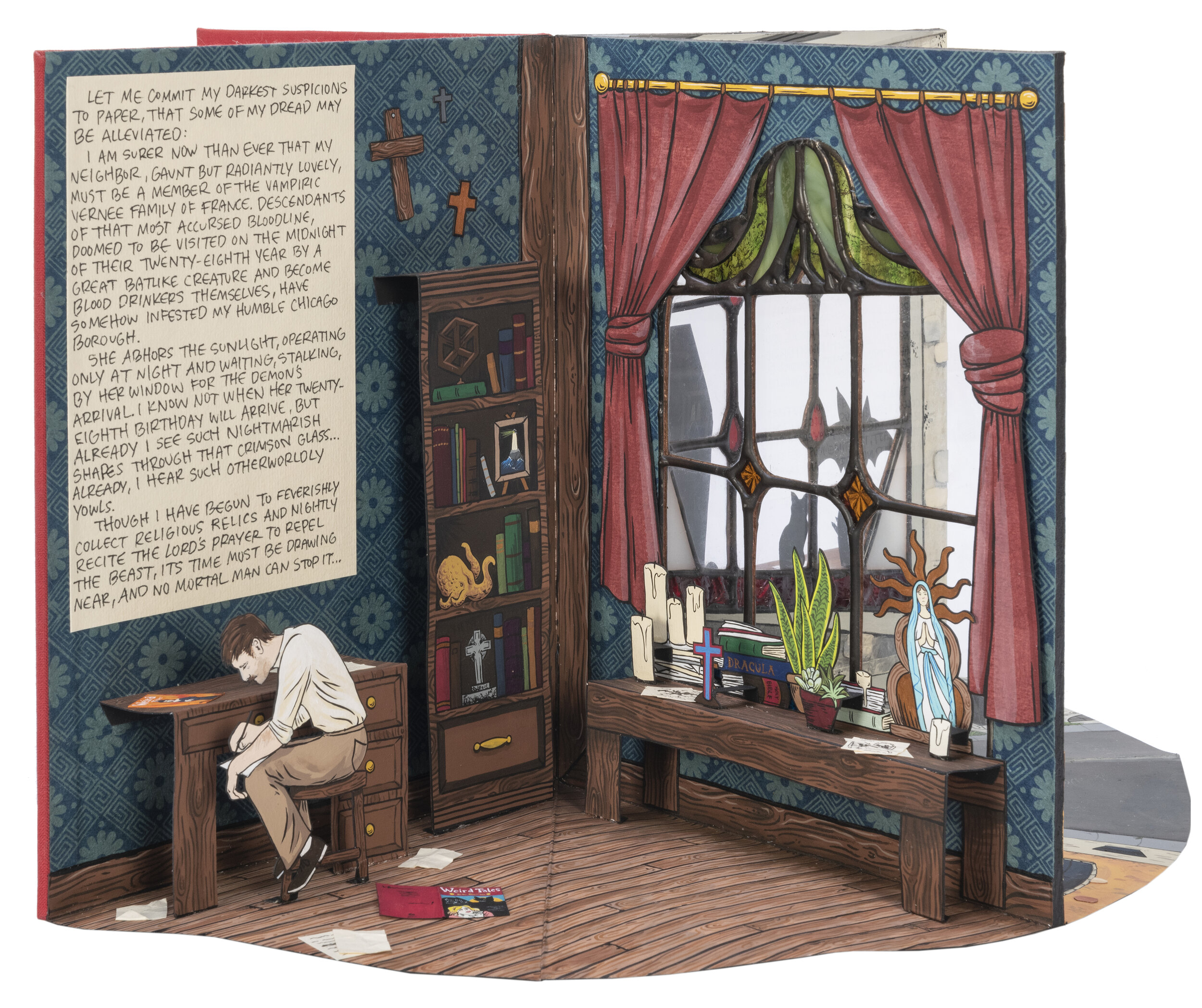
A pop-up book inspired by Weird Tales

Inspired by Weird Tales, an artist tells the story of two readers of Weird Tales living in adjacent apartments, both convinced that the other is a weirdo. Great idea, fantastic execution. Note the issues lying on the floor and in the mailboxes. Link below the pictures.


http://www.hannahbatsel.com/#/weirder-than-fiction/

Saturday, 26 June 2021

Book review: Jim Maitland by Sapper (H. C. McNeile)

Intrigued by David Vineyard's review on Mysteryfile, I went ahead and read Sapper’s Jim Maitland, which collects stories that had previously appeared in Pearson's, McClure's and the Strand. It was considerably easier to find than the Adrian collection. Jim Maitland is a monocle wearing pukka sahib. Possessing private means, he chooses to roam the world in search of adventure. Fair enough, I might choose to do the same if I had the private means. At least the roaming the world part.

H.C. McNeile aka Sapper c. 1924


Jim Maitland by "Sapper" (H. C. McNeile)

Saturday, 29 May 2021

Walker Martin: Collecting Adventure(s)

 [I sent Walker a mail after the recent Heritage Auctions. For those who didn't follow it, the first issue of the Shadow went for $156,000. From  there the conversation went, as it usually does when we chat, to Adventure and what issues were the hardest to find when he was collecting. He sent me a long reply that really made sense as a blog. Enjoy!]

Your question about what years of Adventure did I have the most trouble collecting made me think all the way back to 1972, almost 50 years ago.  When I attended the first Pulpcon in 1972, my main collecting interest was Black Mask and Weird Tales, both of which I was just about finishing up complete sets. I had started collecting them back in 1968 after being discharged from the army.  My main goal back then was not to find a job and start a career, not to get married and raise a family, not to buy a car.  Not any normal goal most men in their twenties would have after the two year disruption in their lives caused by the draft.

No, my main goal was to compile complete sets of Black Mask and Weird Tales along with other detective magazines like Dime Detective and Detective Fiction Weekly.  Also I was on my way to completing sets of all the weird menace pulps like Horror Stories, Terror Tales, Dime Mystery, Thrilling Mystery, and all the Red Circle titles. True, somehow, along the way, I picked up a wife, a family, a job, and a car.  I also got a house but I saw it as a place to store my pulps and hang my original pulp cover paintings.

I had been collecting SF magazines since 1956 when I discovered and bought my first magazine off the newsstand.  It was as if blinders had been lifted off my eyes and at the age of 13 I saw what I thought was the most beautiful thing, the February 1956 issue of Galaxy SF. I quickly started collecting the other SF titles and eventually ended up with almost all the back issues of the old magazines. 


 Fast forward 10 years to 1966 and I'm in the army, away from my collection of SF.  But then a life changing event happened.  Sometimes you hear about books changing your life.  Well it's true. I bought the paperback collection edited by Ron Goulart called THE HARDBOILED DICKS at the army post exchange.  I had stupidly thought that the other adult pulps like the detective titles had not survived. I figured the SF pulps survived because teenage boys and young men had saved them but that grown men had read and thrown away the other genre titles. Goulart's book proved me wrong.  I wrote Ron and he sold me all his copies of the detective pulps for $2 or $3 each.  I was off and running on a lifetime pulp quest of reading and collecting these great old magazines.


By the time the first Pulpcon was held in 1972, I really knew nothing about Adventure magazine but the convention had stacks of the magazine for sale for around a dollar each.  Nils Harden had all ten years of the forties, each year tied up with string.  He wanted $100 but was reserving them for a customer named Harry Noble.  I asked Harry if I could have the set and he said yes because he had been buying pulps for a quarter or 50 cents and didn't want to pay a dollar each.  


Nils Hardin editing an issue of Xenophile

After the convention, I drove to Harry's place in Morristown, NJ to buy more back issues of Adventure. He lived in a converted army barracks on the grounds of Greystone hospital.  For $30 a month the hospital let employees live in these shacks. Harry had a two bedroom tiny apartment full of books and pulps.  He also had 4 children and a wife.  Decades later, at his funeral, I asked one of his daughters how Harry managed to fit everyone in such a small space.  The two girls had one bedroom, the two boys had the other, and Harry and his wife slept on the sofa bed in the living room. I remember seeing the bed which was covered in pulp shreds.  Even the kitchen table was covered in pulp flakes.  When Harry put some chocolate chip cookies on the table you ended up eating cookie crumbs and pulp shreds, a healthy diet that no doubt contributed to his long life.

A drone shot of Greystone Hospital. A suitable residence for a Weird Tales collector.


He had a complete set of Adventure, all 753 pulp issues, 1910-1953.  He also had a couple hundred duplicates which he agreed to sell me at $2 each.  Most were in the 1920's and 1930's.  I still remember Harry slapping down each issue on the table, raising clouds of crumbs and pulp chips, as he chanted $2, $4, $6, etc.  I was in heaven.  Right then Adventure became my favorite magazine and I could hardly drive home in my hurry to read them and find more back issues.

So to answer your question, what years did I have the most trouble collecting?  Hell, none of them.  Back then they did not seem rare at all.  I quickly completed my Adventure set in a couple years, even the harder to find issues in the teens.  In fact, several years later, Harry sold me a complete duplicate set of all the 753 issues and I kept the better condition copies and sold the others through the mail and at Pulpcon.

Ad in Xenophile for Adventure


Though the teen issues(1910-1919) were harder to find, in the 1970's they were still inexpensive.  I don't remember paying more than $2 to $5 each. The only exception being the first issue which I managed to find for $10.  The first few issues in 1910-1911 were published with sturdy book paper which is still white more than a hundred years later.

Adventure issue #1, November 1910

In the 1970's and even the 1980's there were not a lot of people collecting Adventure. I had very little competition while collecting the magazine.  In fact most collectors were interested in the SF pulps and the hero pulps like Doc Savage, The Shadow, The Spider, etc. At first I also collected the hero pulps and soon had almost all of them.  There were some exceptions. I never bothered with Doc Savage because the issues were reprinted in paperback.  I stopped at 150 issues for The Shadow because I tried a dozen times to read the pulp but Walter Gibson's style was just too turgid and long winded. I found all the hero pulps, except maybe The Spider and Secret Agent X, to be not as interesting as the adult pulps like Black Mask, Blue Book, Short Stories, etc.  I soon got rid of them and had to laugh when Harry Noble called them "unreadable crap".  My feeling now is that they were aimed at the teenage boy market.

My favorite years are 1918-1927 when Arthur Sullivant Hoffman was editor.  I've read most of the stories and made notes of my comments, grade, and date read.  All the issues have  pieces of paper with my comments in them.  Now of course the early issues are the hardest to get but it is still possible to put together a complete set of Adventure.  It just takes longer and costs more money. For instance Ed Hulse, in a few years, has managed to find almost all the issues.  Just recently, a few years ago, I was reading a listing of pulp related books for sale from Mike Chomko.  At the very end of a long listing he casually mentioned that he was thinking of selling his Adventures, over 200 issues, all in the 1920's.  I quickly wrote Mike and offered to buy all he had even though I had the issues already.  I was interested in buying them in order to upgrade my copies.  For the next few years I kept asking Mike about them and finally one year he brought the issues to Pulpfest for me to look at.  I spent a few hours looking at them and we completed the sale. I now had over 200 duplicates and Sai was first in line to buy all of them.

(Sai: I was going to buy those but Walker got in ahead of me. Never gives up collecting, and never sells anything, much to my regret.)

I've had a lot of fun reading and collecting Adventure these past 50 years and I miss talking about the magazine with Harry Noble.  I wish I could do it all over again.  I'm getting older now and it's hard to imagine an afterlife without Adventure magazine.  Harry told me if there was an afterlife for book and pulp collectors, he would find a way to let me know. He died at the age of 88 in 2006 but so far there has been nothing but silence.

(Sai: I hope the ghosts of the books we love stay with us in the afterlife.)

Saturday, 10 April 2021

Frank A. Munsey - An annotated bibliography

Frank A. Munsey was a publisher to be reckoned with. The creator of the pulp all-fiction cheap magazine for the masses, he built his publishing business into a mighty conglomerate with businesses in groceries, real estate, banking and publishing. On his death, he left his fortune to the Metropolitan Museum of Art. 

Wanting to learn about him, I started reading one book and hoping to review it - Forty years, forty millions, a biography of Munsey by a newspaper man. I enjoyed it but wanted to verify some of the facts for myself. Searching around, I found a number of articles on and by Munsey and here we are. Tell me of any sources i may have missed in the comments section (you don't need a Google account to comment).

Frank A. Munsey

Saturday, 23 January 2021

Jaundiced eye by William Campbell Gault

I recently came across this article by pulpster William Campbell Gault, originally published in the Summer 1955 issue of the fanzine Grue. Fanzine scanned at the wonderful Fanac.org


JAUNDICED EYE
by Wm Gault


There is a derogatory phrase used by critics in the more enlightened critical journals. The phrase is "pulp writing" and they use it whenever they want to deprecate a man’s technique. What they mean is the kind of writing that used to prevail in the magazines (now mostly dead) that were termed ''pulp" because that was the kind of cheap paper on which the mags were printed. Actually, "action" writing would be more nearly accurate.

Well, the field produced mystery men like Raymond Chandler and Dashiell Hammett and Frederick Haslitt Brennan and the prolific E. S. Gardner. Magazines like the old Argosy, Adventure, Blue Book, Black Mask, Detective Fiction Weekly would be included in the term.

And these magazines produced some fine stories by some exceptionally gifted men. Any critic who took the trouble to read them would be bound to find a few stories he liked. Unfortunately, very few critics can read and oven fewer can think. I imagine what they do is have someone run old tape recordings of Edmund Wilson’s opinions and from them they get certain critic’s phrases and certain blind prejudices. Mr. Wilson was beautifully acid but not always discerning and he had a great lust for the obscure.

Believe me, there is nothing personal in this diatribe; I have enjoyed about an 85 percent favorable critical reception on every book I ever turned out. If this is immodest, it is also statistical and I have clippings to prove it. Besides, I am a hack and know it. And am proud of it, in a way.

My beef is concerned with the readers who might be frightened away from the print market by these hair-splitters. I love the printed medium because no time clock is involved and I hate time clocks. I want to survive in this medium, and quite possibly prevail. And we have such awesome competition, TV and the silver screen and a thousand other entertaining distractions.

I want people to read and I would rather have them read Drano ads than read nothing. And the great scorn of the critics could conceivably put them out of business eventually, a very chilly commercial attitude. But they go blindly on, losing readers and alienating customers.

A man like Truman Capote is searched minutely for symbolisms that give his lavender words a deeper meaning. I respectfully insist that this kind of search would find even deeper meanings in Max Brand. Because even critics can see that Hemingway is great, it distresses them that he has hair on his chest. So he is also searched for symbolism, in order that the critics may safely acclaim him, Mr. Hemingway is about as symbolic as a poke in the nose, but lucidity is a crime to critics and they must have a different reason for liking him. They don’t want to be associated with the people, those horrid things who want to buy books.

Don’t listen to ’em. You go out and buy a book. If you don’t want to strain the budget, buy a two-bit book. You will find one to suit any taste, from Joyce to Spillane. But decide for yourself if you like to read. And if you do, buy some more books and get that library card. You can buy half a dozen for the price of one drink at Ciro's.

Who knows, you might even enjoy reading.

—William Gault

Some things never change. 

Saturday, 14 November 2020

Georges Surdez - Turnstile (from Everybody's Magazine, March 1929)

It's been a while since i posted some action/adventure fiction on this blog. This story originally appeared in the March 1929 issue of Everybody’s magazine. In the last couple of years it was published, Everybody’s became a pulp magazine.  This was a bit surprising as the publishers, The Ridgway Company, already had one pulp magazine in their stable – Adventure. Everybody’s was in the same genre (general action/adventure), used the same authors and illustrators and even the same editor, William Corcoran – the designated successor to Adventure’s Arthur S. Hoffman. So why not just put out more issues of Adventure every month?


Maybe they wanted to clear inventory. At the time, Adventure was being revamped into a more slick-ish magazine of the outdoors. The fiction had to be slanted differently, and finding their inventory of pulp stories surplus to their needs, they recycled it in Everybody’s.

 No matter why it happened, I am glad of that policy as it resulted in more quality action/adventure fiction to read. And here is a cracking example from Surdez, one of Adventure’s most prolific authors. He specialized in French Foreign Legion stories, a genre that has died out today. Most of these involved tough men in tough situations, facing moral choices that resonate even today.

 I won’t spoil the story by telling you more.


Saturday, 7 November 2020

Ernest Bramah's Max Carrados

Here we are the end of this series of posts about blind detectives. I’ve already written about Bramah, so this article focuses on Max Carrados. And there is no better way to appreciate Carrados than to sample his stories. I’ve read all three collections of the Carrados stories: Max Carrados, The Eyes of Max Carrados and Max Carrados Mysteries

From these, I've picked my favorites and added a quote so that you can get a flavor of Bramah’s writing. All these stories and a few others are collected in the Dover reprint, The best Max Carrados mystery stories, which includes a great introduction by E.F. Bleiler.


The best Max Carrados detective stories

Saturday, 31 October 2020

A Damon Gaunt mystery - Eyes that saw not

Continued from last week's post on Isabel Ostrander, the creator of the blind detective Damon Gaunt

Unlike Thornley Colton, who displayed his skills in a number of novella length tales before getting into a novel-length adventure, Damon Gaunt's first appearance is in a serialized novel. Because of the bigger  scope of the novel, he doesn't have to show off his skills till about thirty paragraphs in. His first deduction is that the person who has brought him the case of Garrett Appleton, murdered at his home, is a cocaine addict. He bases this on the constant sniffing and rubbing of his nose.


Saturday, 24 October 2020

Isabel Ostrander - Author

Isabel Ostrander was a prolific writer in the early twentieth century, contributing more than thirty serials using three pseudonyms, and perhaps more under other names, to the Munsey and Street and Smith pulps in little over a decade before her untimely death. Many of these serials were later reprinted as novels, some with changed titles.

Her inclusion in this series of articles is due to her creation of Damon Gaunt, the second blind detective to feature in American fiction. The first was Thornley Colton, created by Clinton H. Stagg. Damon Gaunt is however, closer to the British school of detective fiction epitomized by Agatha Christie’s Hercule Poirot. How? We’ll see later.

Isabel Ostrander c. 1907

Saturday, 17 October 2020

Bibliography of the Thornley Colton stories

Continued from last week's post on Clinton H. Stagg who the creator of the first blind detective, Thornley Colton.All eight Thornley Colton stories were published in People’s magazine, Street and Smith’s companion to The Popular Magazine , from February 1913 to October 1913. One story per issue except for August 1913. People’s is one of those ultra-rare pulps you don’t hear much about, because most people haven’t seen a copy, let alone read an issue.

Which is why it is fortunate that all the Colton stories and the novel were recently reprinted by Coachwhip Publications. Coachwhip is a small print-on-demand publisher that publishes an eclectic mix of titles on crypto-zoology, mysteries, history and business. Their mystery lineup is worth checking out.

Saturday, 10 October 2020

Clinton H. Stagg - Author, Script Writer, News Reporter


Clinton Holland Stagg, the creator of the first fictional blind detective, was born on 22 November 1888 in Newark, Essex, New Jersey to William E. Stagg and Annie Stagg (neé Holland). There is no record of his father’s profession at the time of his birth. In the 1900 census, Clinton is listed as “At School”, and his father’s occupation is “Machinist”. The family had moved to Bloomfield, less than 10 miles distant from Newark. A younger brother, Horace was 9 years old and attending school.

Clinton H. Stagg - Creator of the first blind fictional detective

Saturday, 3 October 2020

The first blind detective in modern English fiction

October is Blindness Awareness Month when the National Federation for the Blind (NFB), holds outreach activities to create opportunities for people to meet blind people living in their communities and to realize that blind people are vital contributing members of society.

My small contribution to this is to get you to meet the earliest blind detectives and their authors. Three of them in fact:

Clinton H. Stagg’s Thornley Colton appeared in a series of stories in Street & Smith’s People’s Ideal Fiction Magazine starting in February 1913
Ernest Bramah’s Max Carrados made his debut in the British tabloid, The News of the World on August 17, 1913 and made one appearance in Flynn’s Detective Fiction
Isabel Ostrander’s Damon Gaunt appeared in the Munsey pulps - The Cavalier, The Argosy, first appearance not known to be earlier than February 1914


Thornley Colton appeared in eight stories in People’s Ideal Fiction Magazine from February to October 1913, beating Ernest Bramah’s Max Carrados (first appearance in The Coin of Dionysus, published in News of the World, August 17, 1913) by six months, and Isabel Ostrander’s Damon Gaunt by over a year (first appearance in Eyes that see not, published in The Cavalier, Feb 14, 1914). It’s possible that there could be an even earlier story, yet undiscovered, but until then Stagg and Colton have first place in the pantheon of blind detectives.

Hellen Keller (photo courtesy the Library of Congress)

Why did so many blind detectives appear at around the same time? I think it had to do with Helen Keller. Born in 1880, she overcame many obstacles to become the first deaf-blind graduate of Radcliffe College for women. She graduated summa-cum-laude, and published her autobiography in 1902. The Story of My Life was a best-seller, and by 1913, Keller was on a lecture tour around the United States, going from city to city and giving talks on her experience as a blind person.

By 1913 the world had seen blind people match their sighted brethren in skills and accomplishments. Sir Arthur Conan Doyle had been writing Sherlock Holmes’ stories for over a quarter century, and detective stories were a staple of popular fiction in the all-fiction rough paper magazines and their more sophisticated counterparts. Then, as now, an author of detective fiction needed something different –the setting, the crime, the detective or the criminal - to differentiate his story from the crowd. While Stagg wasn’t unique in picking blindness as his detective’s distinguishing characteristic, he was the first to be published.

Next week: Clinton Stagg and Thornley Colton

Friday, 21 August 2020

Walker Martin: Collecting and Reading Black Mask

[In a recent mail thread with Walker Martin, I was joking about how his set of Black Mask would have kept him safe from the coronavirus, if only he hadn't sold it. He could have read every issue while saying to his family - "See, a Mask a day keeps you safe." 

Because he's a nice guy, he responded to this sick humor with a mail about collecting Black Mask. Sensing an opportunity for a free article on this blog, i asked him a few more questions and he responded to those too. The result is what you have before you today. 

If you want more in this vein, tell Walker that. Leave a note in the comments section - you don't have to have a Google login to do that.] 

Your question about Black Mask has started me thinking about how I collected the set and then read most of it.  In fact, I've often said once you complete a set and then read much of it, the next step in the collecting process is to sell it.

I may have told you this story before and some of it I wrote online for Mystery File back when I started the Collecting Pulps: A Memoir series but it all started when I was drafted into the army in 1966.  The Vietnam war was heating up and I was headed for an infantry company when the army discovered I knew how to type thus possibly saving my life. I now had plenty of time to read and while in the PX I noticed Ron Goulart's The Hardboiled Dicks.


US Army PX - inset image of Ron Goulart's The Hardboiled Dicks